Showing posts with label Activism. Show all posts

Wednesday, April 8, 2026

A decision maker seduced by previous military successes

My Sunday movie was A Nice Indian Boy. The story centers on Naveen, a young gay man who is a doctor. He’s rather timid. He’s also annoyed that at his sister’s wedding everyone tells him, “You’re next.” A few years later Naveen meets Jay (played by Jonathan Groff). He’s white though adopted by Indian parents so knows the culture – somewhat. They seem to fall in love quickly. This is a romance story and follows the formula. The difficulty here is when Naveen finally gets the courage to take Jay to meet his sister and parents things don’t go well, more from misunderstanding than homophobia. The second difficulty was how to fit a gay couple into a traditional Indian wedding. I enjoyed it. Nearly all of the threads of the story conclude in the way one would want. The movie has a bunch of award nominations and a few wins. Zarna Garg plays Naveen’s mother. She is an Indian American comedian. Back in mid February she was interviewed for Pridesource by Chris Azzopardi. She talked about being an ally and working to tell other parents they need to support their queer kids, well, queer people in general. As part of the interview Garg said that her friends who are gay have the highest EQ of the people she knows. I had to verify what that means – Emotional Quotient or Emotional Intelligence, the ability to recognize the emotions in themselves and others to guide thinking and behavior. Garg says she’s used to the “brown guys” who avoid emotional friction and was startled when the gays around her are so empathetic. She also tells the story of her sister, who became an ally because of the movie. The family lived in Ohio after they came from India. The sister booked theaters across Ohio, telling Indians they have an obligation to see the movie. There is no excuse, it’s all paid for. I finished the book My Government Means to Kill Me, a novel by Rasheed Newson. The story isn’t as dire as the title might sound. The phrase comes from something many LGBTQ people, especially black gay men, figure out about their interactions with the government. The story is about Trey, called that because his full name includes “III” and he’s trying to distance himself from his family. He’s black and gay. He grew up in Indianapolis in a house big enough his parents named it. In 1986 at 17 he flees to New York City, rejecting the family wealth. At first, this reads like a biography instead of a novel. But then one notices the little differences between the story and history. Trey is mentored by Bayard Rustin, the gay assistant to Martin Luther King who did a lot of work to organize the 1963 March on Washington. They meet and do most of their talking at a gay bath house and a footnote tells us there is no evidence that Rustin ever visited a bath house. That bath house is where Trey finds his community (and a whole lot of sex). Through the rest of the book there are another 80 footnotes explaining the gay cultural significance of historical people, places, and songs that Trey and others meet or mention. This is Trey’s coming of age story, including how he becomes an activist. He becomes a volunteer for Gay Men’s Health Crisis (this is the AIDS era) an early member of ACT UP, founded by Larry Kramer. One of his early actions is to tangle with Fred Trump (yes, that Fred Trump), the racist slumlord who hid behind interlocking corporations. Each chapter’s title is a lesson he as an activist needs to learn, such as: “Devils Have a Weakness.” “Allies Don’t Always Harmonize.” “The Best Spontaneous Moments are Planned,” which is about the work that was done before Larry Kramer’s famous “last minute” speech that prompted the creation of ACT UP. I enjoyed the story and recommend it as a look into the history of gay activism in the AIDS era in NYC. Though there was a lot of the story I already knew there were a few things I didn’t. Reading about a participant in this era, even if a fictional one, leads to a greater understanding of what they went through. Yes, Trey spends a lot of time in a bath house engaging in sex during the AIDS era. He speculates the reason why it was allowed to stay open is because the clientele was mostly black. The news this morning was that there is a two week ceasefire between US/Israel and Iran and that the Strait of Hormuz is open. The news this evening was the Strait was closed again and Israel is still firing on Lebanon, because Israel claimed that Hezbollah wasn’t part of the deal. Check news again in the morning. Ilan Goldenberg tweeted:
I am thankful that we have a ceasefire. It happened much faster than I expected and it was the right move. But let’s be clear that this war ends (if the ceasefire holds) as a total strategic disaster. The scorecard: Nukes: Iran still has the HEU [Highly Enriched Uranium] Proxies: no change or impact Missile and drones: Iran demonstrated its arsenal is sustainable and survivable under massive US and Israeli pressure. Strait of Hormuz: Iran’s leverage to use it as a bargaining chip has dramatically increased.
There is more, some of which I’ll summarize: + The son of the Supreme Leader has the job and is likely stronger. + US Gulf allies screwed, relations with Europe strained. + Israel is more isolated and no more secure. + Global economy: major damage. In a previous post I mentioned that the nasty guy fired Pam Bondi as Attorney General. If you still need a news article or two about it here’s one by Oliver Willis of Daily Kos and one by Lisa Needham of Kos. The second one adds that Deputy Attorney General Todd Blanche will take the top job until a replacement can be confirmed so Needham reviews why the nasty guy likes him and why we won’t. I had also previously mentioned that Defense Secretary Pete Hegseth had fired – asked to take early retirement – Gen. Randy George, the Army chief of staff, a very strange thing to do in the middle of a war. An Associated Press article posted on Kos explains who George is. Jeremy Lindenfeld, in an article for Capital & Main posted on Kos, discussed the Imperial Valley, the region in California between the Salton Sea and the Mexican border. This is a fertile area for both white and Native farmers, but only because of water from the Colorado River. Because of global warming (I hear March set a record in heat) and a drought in the West the water level in the Colorado River has dropped. A lot of farmers have adopted methods to use less water, but they may need to reduce more. Now also snooping around the valley are companies that want to mine lithium from the enormous underground reservoir of geothermal brine and to set up data centers. Both need lots of water with the Colorado River being the only source. That loss of water could drive a lot of farmers out of business. In Monday’s pundit roundup for Kos Greg Dworkin quoted Heath Mayo commenting on the search and rescue effort for the downed Air Force pilot.
One emerging theme of the war effort is that (1) our military is extremely competent and extremely good at war fighting and doing its job even as (2) our political leadership that sets the strategic ends and objectives for military action has absolutely no clue what it’s doing.
David Baer of The Bulwark discussed the election in Hungary, which is this weekend. Baer’s title (from a week ago) says it well, “Orbán Will Lose Hungary’s Election in Two Weeks—If It’s Clean.” Baer then lists all the levers of power that dictator Orbán has seized or crafted for himself, enough for observers to think he can’t be removed. Then Baer describes Orbán’s opponent, Péter Magyar. So, back to that bit in the title, “If It’s Clean.” Idrees Kahloon of The Atlantic:
The Hormuz crisis has some beneficiaries: America’s adversaries. To prevent even higher oil prices, the Trump administration has lifted sanctions on Russian exports and even some of Iran’s. “Things that Iran and Russia had sought to achieve through negotiations with the United States, they’ve managed to achieve without having to negotiate,” Michael Froman, the president of the Council on Foreign Relations, told me. “This is bailing out the Russian economy, which had been on the ropes, and, at least temporarily, it is giving a windfall to Iran.” Russia could recoup an additional $40 billion or more in oil exports this year, which it can plow into its war effort against Ukraine. Iranian oil production may be as high as before the war.
A tweet by Gandalv, which includes a video (which I did not listen to):
Retired Lt. Gen. Mark Hertling is not mincing words. The former Commanding General of US Army Europe says these generals were purged because they stood up against Pete Hegseth’s push to turn the US military into a Christian nationalist crusade. Retired Army Maj. Gen. Randy Manner says dozens of chaplains who don’t share Hegseth’s views are being marginalized and excluded from staff meetings. The chaplain corps exists to serve all service members regardless of faith. That apparently made Green’s position untenable. The Pope has now weighed in. Hegseth’s prayer for battlefield violence prompted a response from Rome: God does not listen to those who wage war in his name. Hertling has seen enough. So have the troops.
On Tuesday Willis reported the nasty guy had tweeted Iran should concede and do so quickly or “a whole civilization will die tonight, never to be brought back again.” Yeah, that’s a vile thing for an Oval Office Occupant to say. Experts said the particulars would likely be war crimes. Willis reminds us that back in November Democrats warned us of such things. That’s when several members of Congress released a video saying military personnel have a duty to not follow illegal orders. Of course, the nasty guy and his minions tried to make life hard for the creators of the video, especially Sen. Mark Kelly. But prosecutors weren’t able to find an actual crime that had been committed. In Tuesday’s roundup Chitown Kev quoted Shane Harris of The Atlantic:
If a...panel of experts scrutinized the run-up to the current war in Iran, their assessment might go something like this: The intelligence community was accurate and consistent in its prewar judgments about Iran’s capabilities and intentions to attack the United States and its allies. Contrary to what President Trump has said to justify his decision, the intelligence showed that the Iranian regime was not preparing to use a nuclear weapon; it did not have ballistic missiles capable of reaching the United States; and in response to a U.S. military attack, Iran was likely to strike at neighboring countries in the Persian Gulf and try to close the Strait of Hormuz, precipitating a global economic crisis. All of this was known before the war and presented to President Trump. This was an intelligence success. […] The failures of the intelligence community on Iraq’s WMDs produced systemic changes meant to keep botched calls like that one from recurring. In many respects, those reforms have worked. But they couldn’t account for a decision maker who had been seduced by previous military successes into thinking that the U.S. armed forces, under his inspired and perhaps divinely endowed command, could never stumble.
In Wednesday’s roundup Dworkin included a tweet by Aaron Blake discussing the firing of AG Pam Bondi and Todd Blanche as her interim replacement.
Even in her confirmation hearing, Bondi assured cases would be judged on their merits -- "No one will be prosecuted, investigated because they are a political opponent." Here, Blanche conveys a more relaxed standard where the president just gets to order stuff.
That “here” is a tweet from Acyn:
Blanche: We have thousands of ongoing investigations going on and it is true that some of them involve men, women, and entities that the president believes should be investigated. That is his right and it is his duty to do that—meaning to lead this country.
In the comments is a tweet by David Shiffman. The image is a reworking of a meme I’ve seen before in which a rich man with a plate mounded with cookies sits between a white worker with a plate with one cookie and an immigrant worker with nothing in front of him. The rich man says to the white worker, “Careful mate... that immigrant wants your cookie!” Shiffman reworked the meme in response to the nasty guy issuing a proposed 2027 budget that increased the military budget by 40% to $1.4 trillion and saying the budget had no room for the social safety net. Over the rich guy’s face he put “ICE, War in Iran.” Over the white worker’s face he put, “Medicaid, Medicare, and daycare.” Over the immigrant he put the emblems of NASA, NOAA, EPA, NSF, NIH, and the Fish and Wildlife Service. The rich guy says, “Careful mate... that science wants your cookie!” Shiffman added:
Science is not why you and your family are struggling, friends. President Trump and Congressional Republicans are the reason why you and your family are struggling.
Tweets by Max Burns:
You guys don’t get Trump’s 4D chess. He had to attack Iran in order to open the Strait of Hormuz which was open before he attacked Iran. So Donald Trump fought this disastrous war with Iran and the end result is a deal in which Iran gets: – Control of the Strait of Hormuz – Unlimited uranium enrichment – All U.S. sanctions lifted – All U.N. resolutions against it lifted – Cash compensation from the US Who won again?
And just for fun, Fergi Jo Lisa posted a 15 second video of a bird (I think a parrot) and six dogs.

Saturday, January 22, 2022

Could we interest you in a lively debate about the gender of M&Ms instead?

I downloaded the Michigan COVID data, updated as of Friday. In new cases per day the large peak at the start of January has been revised upward to 26,786. Thankfully, the peaks in the two weeks after that are at 22,065 and 17,043. In the last two weeks the deaths per day dropped from 95 to 62, then rose over three days to 116, then dropped to 52. There are only 11 undated deaths. I don’t know what happened to the 1100 undated deaths shown in the previous report. Public Citizen tweeted:
Imagine this: The wealth of you & your friends doubled to $1,500,000,000,000 during Covid. If those gains were taxed by 99%, you all are STILL richer than 99% of the world. That revenue could vaccinate the planet & save lives. This is the power of the world’s 10 richest men.
Archaeologist Dr. Sarah Parcak tweeted:
Archaeologists: Here's exactly how pandemics have played out in the past w 10 top examples Historians: Here's how the 1919 pandemic played out blow by blow w masks surges deaths Sociologists: Here's how people react to vaccines+ masks w 100 papers Politicians: THIS IS ALL NEW
It seems all new to the media too. Greg Dworkin, in a pundit roundup for Daily Kos (from almost three weeks ago), included a tweet from Bob Wachter which shows a plot of states positioned according to the percent of population fully vaccinated and deaths per million people since July. The plot shows a pretty high negative correlation – as vaccination rate increases the death rate goes down. Dworkin also quoted Will Bunch of the Philadelphia Inquirer, discussing schools that are always underfunded.
“What use would a carpenter have for biology?” asked [John] Krill [a lawyer for a Republican lawmaker], questioning the need for learning for learning’s sake in a locale where many of the available jobs don’t require a college degree. In stating so plainly the modern conservative philosophy that public schools exist solely to develop a workforce — one in which not everyone need be a rocket scientist or a philosopher — the Harvard Law-educated Krill didn’t stop there.
Carpenter and biology? Wouldn’t it be good to understand where the wood comes from? In addition to learning for learning’s sake is the need to educate people on how to be responsible citizens in a democracy. Clearly, Republicans don’t want that, either. The NPR program It’s Been a Minute with host Sam Sanders is on Michigan Radio on Saturdays. I usually don’t listen, though today’s episode sounded intriguing and important. It was a repeat of an episode from last June in which Sanders talked to Sarah Schulman. She had written the book Let the Record Show: A Political History of ACT UP New York, 1987-1993 and she had been a part of the group for much of that time. This link is for last June’s show with the 50 minute audio, a few photos, and interview highlights. Here’s a bit from what I remember from the audio. The AIDS pandemic started in 1981. Gay men and allies organized to take care of their own. By 1987 they realized – prompted by Larry Kramer – that caregiving wasn’t enough. COVID is a very public pandemic. AIDS wasn’t, so one goal of ACT UP was to get the mainstream media to pay attention. Those who lived through that era will likely remember their slogan “Silence = Death.” Another goal was to change policy. So this large coalition would study an issue, create an alternate policy, then make noise so the institution would pay attention. One of their most successful actions was against the Food and Drug Administration who were being mighty slow in approving drugs to treat AIDS. One part of the alternate policy was to say don’t test a drug against a placebo because the person who gets the placebo will die. Instead, test against the best known treatment. They didn’t protest on the weekend when no one would be in the building. Instead, they protested during a weekday so the workers inside would feel a bit uneasy and no work would get done. The FDA changed their policy. One of their most famous actions was at St. Patrick’s Cathedral in New York. Cardinal O’Connor started demanding the city restrict HIV related materials from being available in public schools. The ACT UP team felt he had overstepped his authority, resulting on more deaths. So on December 10, 1989 they came into a mass and did a quiet die-in. That was effective. Then one man, defying agreed action protocols, stood on a pew and repeatedly shouted, “Stop Killing Us!” Things got a bit chaotic after that and police were called. Even with that deviation from the plan the action was considered a success. They definitely got media attention. And the perception of gay men shifted from weak to strong. Schulman wrote the book to both give an account of her time in the group and to give a training manual to those needing to protest today. And groups like Black Lives Matter and those who support immigrants are following ACT UP’s example. Ruth Ben-Ghiat quoted Hugo Lowell of the Guardian:
Sources tell me Jan. 6 committee may only subpoena GOP members of Congress if it can overcome one major recurring worry raised in conversations: fear of Republican retaliation in the future.
Ben-Ghiat added:
Hello from: lessons from authoritarian history. Fear of retaliation=old school democratic frame. Realism= knowing they will go after everyone they can anyway. Only bold and fearless action works w/ppl who thrill at breaking the rules and see caution as weakness.
Professor Crystal Marie Fleming tweeted (almost three weeks ago):
We have a dynamic wherein Republicans know our “democratic” institutions aren’t actually democratic and would like to further undermine them with open fascism while Democrats are invested in pretending our civic institutions work. The latter position is very easy to manipulate. Because Democrats refuse to publicly admit the problem — that our core institutions are weak and undemocratic — the opposing party can get away with almost anything, including open coup attempts! while Dems scramble to keep pretending that everything is still legitimate and okay. Republicans and foreign adversaries alike know that the party line from Democrats will continue to be “Everything is fine actually” no matter how s---ty things are. I personally believe that even if the coup had been successful, Dems still would have asked to form a committee.
Leah McElrath tweeted:
Fiction tells us families come together after a death, but, in reality, they usually don’t. Instead, what often happens is previously existing toxic dynamics become more intense, not less. Sometimes family ties break altogether. I feel like that’s happening now, with humanity. We are facing multiple, literal existential crises. A pandemic has killed millions. Climate change is causing us to face the increasing uninhabitability—in real time—of many areas in which we live. One would imagine the natural response would be for us to become more united. Instead, we cannot help but notice the pronounced fragmentation. As is the case within families, some benefit from the pre-existing fragmentation. Accordingly, in response to a threat of systemic upheaval, they endeavor not only to ensure splits remain but also to widen them. Because of our own sense of urgency, we can feel compelled to focus on those invested in maintaining division. It can feel necessary that they change. The need for them to change can even feel like a survival need as, over time, engagement evolves into repetition compulsion. My fear is that our continued focus on trying to “fix” the divisions is inadvertently serving to strengthen them.
McElrath quoted ContextFall who tweeted:
At what point does the general public realize that there is a major PR effort pushing the normalization of mass death?
McElrath added:
We’ve seen a 3-year-lag between when MSM journalists mock those of us who observe patterns to when those journalists finally start writing about the patterns as obvious truths—and a 2-year-lag until the public consumes enough MSM coverage to create a body of common knowledge.
I heard a bit of news that the makers of M&Ms candy have given the animated candies used in commercials a makeover. It looks like Tucker Carlson of Fox News ranted about the brown candy character appearing to be non-binary. That prompted Ken Klippenstein of The Intercept to tweet:
Sorry you don’t get a say in the distribution of resources, could we interest you in a lively debate about the gender of M&Ms instead? Note: You will now be paid in M&Ms
Bill in Portland, Maine, in his Cheers and Jeers column for Kos, quoted late night commentary.
Republicans are being criticized for blocking the voting rights bill. But, of course, Republicans don’t want voting rights because if voting was fair they'd lose. It's the same reason I keep my basketball hoop lowered to eight feet: because with the help of a small ladder, I can dunk. —Colin Jost, SNL Republicans are afraid that if more people get access to voting, they’re gonna lose elections. So, instead of coming up with policies that are more popular, they make it harder to vote. Basically, Republicans believe in the free market for everything except themselves. —Trevor Noah, The Daily Show
I haven’t heard much about Thich Nhat Hanh, a peacemaker who died this week. Bernice King, daughter of MLK, tweeted a bit of background. He was a friend and ally with MLK and urged opposition to the Vietnam war. That opposition meant he was exiled from his home country. When MLK was nominated for the Nobel Peace Price in 1967 he said Thich Nhat Hanh was more worthy. The prize wasn’t awarded that year. Rabbi Danya Ruttenberg tweeted:
“To be loved means to be recognized as existing." —Thich Nhat Hanh To see one another. Honor the dignity of one another. Fight for justice for one another. Build a world that recognizes the full existence of everyone. That’s our work.

Sunday, October 24, 2021

To exhaust your critical thinking, to annihilate truth

Kos of Daily Kos has been writing daily Anti-vaxx Chronicles in which a person who is highly outspoken against the COVID vaccines dies of COVID. He gets the stories from a subreddit of Reddit. I may have shared one of these stories. I stopped reading them because they’re pretty much all the same. Kos documents how loudly the person was adamant about the vaccine on social media, then documents their death. Yesterday, Kos took a break from that (though those stories will be back) to start a series of stories from the Parler Watch subreddit of Reddit. Parler is, of course, a far right media platform used to plan the Capitol attack. Reddit goes to Parler and Kos goes to Reddit so you and I don’t have to yet still get a bit of the story. Today’s chapter (and I probably won’t share more) is about the insurrectionist fantasies of a conservative vs. liberal civil war. The fantasy is that several liberal bastions – Chicago, Detroit, Atlanta, then Washington DC – would fall rather quickly to the conservative forces. Kos responded with laughter. Did the fantasist consider who in Chicago owns the guns?
I do wish they’d settle on a narrative: Are liberals violent and dangerous, driven by antifa and BLM, or are liberals weak and cowardly? Because if they’re really worried about antifa and BLM, then oh boy, best of luck, y’all!
Kos also discussed several other aspects of logistics that weren’t taken into account. However, he does say a Second Civil War would be catastrophic to the nation. Kos concluded:
They don’t want a war. No one wins in any civil war. We already had one here which pitted the industrialized, technologically advanced, populated side of America versus the rural agrarian side. It didn’t go so well. What these zealots really want is a genocide. And that’s the real terror in this. These are domestic terrorists. And like all terrorists, it only takes one to create mass carnage.
Even as we might laugh at these war fantasies the situation is still serious, as Ben Franklin tweeted in a thread:
Our opposition does not have the power to suppress a fully mobilized democracy movement. They just don’t have the numbers. This is why media and social media warfare is so important - it keeps people clueless, confused, waiting on a savior, totally demobilized. The primary tools used to stop a fully mobilized democracy is 1) convincing people that the situation is not serious 2) saying it's a serious situation but convincing people that the institutions have it under control 3) funneling political activity exclusively into voting. ... Has winning the White House and congress led to a meaningful change in law enforcement? Do you believe the GOP is going to honor unfavorable election results? Do you think they intend to allow fair and free elections to begin with? They are moving this outside traditional norms. So what, you may ask, can we possibly do? We are not the first country or democracy to face an authoritarian movement, a coup attempt. What you see in so many countries around the world is a mass civic mobilization in response. And sometimes - they beat the authoritarians.
Alas, Franklin didn’t discuss who is (or should be) leading us to mobilize to save our democracy. As one who has receive many solicitations for my help to get out the vote for this race or that, I’m sure Democrats won’t be leading this mobilization. So who? Garry Kasparov tweeted this back in 2016, then a couple months ago put it back in his Twitter feed, where it hid in my browser tabs for a while:
The point of modern propaganda isn't only to misinform or push an agenda. It is to exhaust your critical thinking, to annihilate truth.
A couple weeks ago Ian Reifowitz of Kos sang the praises of bureaucrats who defied the nasty guy. These defiant workers included those at the US Census who worked to make the data as accurate as possible, that minority people were properly counted, while defying political interference. There was also General Mike Milley, head of the Joint Chiefs of Staff, who quietly called his counterpart in Beijing that the Capitol attack would not include shooting off nuclear weapons in China’s direction. White House Counsel Don McGahn was ordered by the nasty guy to fire Special Counsel Robert Mueller. McGahn refused and quit. Career scientists at NOAA had limited success in blocking directives supporting climate change denial. There are, of course, many others. Leah McElrath tweeted a thread:
Being an activist is a thankless task. No one likes you if you’re doing it right. The non-activists of your own people on whose behalf you’re acting will not like you. Read that again. Take it in. Then years later, they’ll rewrite history and pretend they too were activists. Activism makes people uncomfortable. Activism aims to create change. People don’t like discomfort, and people fear change—EVEN OPPRESSED PEOPLE. Everyone criticizes the work of activists when it’s happening because it makes them uncomfortable and fearful. Do it anyway. My words are not about a specific movement now but about the future: We are in a dark time headed into greater darkness. We have to be prepared to be our own light. We have to be ready to do what is right without guarantee of success in our lifetimes. And we will not be thanked.
McElrath was responding to a thread by Dan Canon:
Hi, I was one of the lawyers who won Obergefell at SCOTUS and litigated the Kim Davis case in Kentucky. Back when Trump was elected, I said same-sex couples didn't have to be worried about their marriages. I was wrong. ... The unwillingness of SCOTUS to do anything about SB8 sent a clear signal to red-state legislatures: 'do whatever you want, the courts won't stop you.' TX GOP heard that message loud and clear. Look for this in all other red states too, certainly by next session if not before.
Canon then linked to an article exploring the idea in more detail. Then he suggests that if you live in a red state maybe it is time to move. Kerry Eleveld of Kos reported Sen. Kyrsten Sinema, who has been obstructing Biden’s Build Back Better bill, said she would refuse to support a bill that raises taxes on corporations and multimillionaires. That means there is room to consider a billionaire tax. This is a tax proposed by Sen. Elizabeth Warren during her 2020 presidential race. Sen. Ron Wyden, chair of the Senate Finance Committee, is now taking up the idea. The version being discussed now is a tax on the increase in the value of assets, even if the assets are not sold. The thresholds are set (at the moment) so that it would affect only 700 people in the country. Most Democrats are for it, likely even Manchin and Sinema. Those not in favor are concerned about how to figure out how much wealth a person has and how much that wealth increased in the last year (of course they’re going to cheat – tax them anyway). Mark Sumner of Kos discussed that climate change might hurt Republicans (and Sen. Manchin) and their fossil fuel donors in the place that matters most – their wallet. There have already been reports, even a few this week, on how the climate crisis is affecting and will affect things. There is the extreme weather and the cost of recovering from them, the hit to marginalized communities, and the likely appearance of climate refugees within the US (and many millions more around the globe). All these disasters prompt a reconsideration of how things are valued. The taint of fossil fuel stocks may become more widely acknowledged, causing a drop in stock prices. The sharply dropping cost of electricity from renewables plus the increased use of electric cars means prices for oil and natural gas could drop quickly. It’s already happened to coal. Sumner wrote:
The whole fossil fuel sector could see much of its value erased as demand for those fuels crashes and investors take flight. Considering the size and value currently assigned to some of these companies, such a shift could not just spell doom for the fossil fuel corporations, but leave state governments, retirement funds, and individual investors holding the (suddenly empty) bag. Homes in areas dedicated to coal mining or oil and gas drilling could become worthless. So could massive refineries, giant port facilities, and thousands of miles of pipeline.
Will we embrace the change and properly manage the switch away from fossil fuels, including helping all the people affected by the change? Or will we try to drag out the death of fossil fuels?

Thursday, October 10, 2013

The country and world are watching Detroit

Yeah, I know it's been a week since I last posted. The weekend was so busy I needed to go back to work to rest up. And my work week doesn't leave much time to write.

Saturday morning I joined a crew to Board Up Blight. This was a team that assembled at the Scott Center, part of Cass Community Social Services, associated with the Cass Community United Methodist Church. The Saturday crew was brought together through the Hands4Detroit program run by the Detroit district of the UMC. There were several other projects elsewhere in Detroit and Pontiac. Apparently the total number of volunteers was over 1100 (some showing up that morning). A few sites had more volunteers than they could keep busy.

The crew of 20 that I joined walked a couple blocks north of the Scott Center, an area southwest of Davison and Lodge. There are currently 7 houses on the block and at least that many vacant lots. Out of those 7 houses only one is currently occupied. Of the rest… One was badly burned, not much more than a few walls and chimney that didn't look stable. A couple others showed scars of fire. All were quite thoroughly trashed.

Our job was to board up first floor windows and doors, haul out the yard trash, and cut down overgrown shrubs and small trees -- especially the kind that grow when no one is looking. We hauled out a great deal of trash. I wondered a bit over the cancelled checks from 1979 and the intact newspaper from 1975. There were also lots of body parts -- from a manikin. We worked from about 9:30 to noon, had a lunch break and then 1:00 to 2:00. The street looked a lot better when we were done, though it was lined with garbage bags and cut branches for someone to haul away. All this effort prompted the lone resident to do a bit of yard work of his own.

I don't know how long these houses have been vacant. A year? Ten? Even so, I thought about the banks sucking value from the city through foreclosures and leaving teams like ours to clean up after them.

From there I went downtown to Grand Circus Park and the International People's Assembly Against the Banks and Against Austerity. This was put on by Detroit Eviction Defense and Moratorium Now, two groups that have sponsored protests I've participated in. There were probably other groups involved in the planning. The assembly had been going since 10:00 that morning. Alas, the whole thing looked a lot smaller than I expected -- just a couple tents and a handful of booths along Woodward.

When I got there one of the tents held a workshop talking about the power structures in Detroit. They are, in order:

Economic, the wealthy people and the big companies (they were named), including the car companies. If these people want something done, it gets done. That doesn't mean it is in the best interest of the city and its citizens.

Political, including city and state officials. The state is listed because many of Detroit's difficulties are a result of state action, such as the Emergency Manager law and various revenue sharing programs the state doles out or (more frequently) withholds.

Media, the big corporate owned newspapers and the independent weeklies. Corporate papers are important because they control what residents think and if the papers don't discuss possible solutions (the ones that aren't in a corporation's benefit) residents don't know about them. We were urged to read the independents and to be our own media. That's what I'm doing now.

Non-profit, mostly foundations set up by the economic powers. The powers also fill their boards. This allows the rich to hide behind a non-profit which enforces their power. It also allows the rich to do a little something about the collateral damage their policies create.

We all assembled under one tent for the afternoon series of speakers. Some were video clips or written statements from fellow strugglers elsewhere in the world.

The first statement was from the Haitian community in Oakland about the situation in Haiti. Since the earthquake (nearly 4 years ago?) the situation is still dire for many people. Most of the aid money has ended up in the pockets of the rich. The poor still live in tents.

The next message was from Portland, OR. That was followed by a video from the Philippines. This speaker seemed to know a great deal about the situation in Detroit.

Laura Gottesdiener is the author of the book A Dream Foreclosed. She said Detroit is on the front lines in the battle between the 1% and the 99%. The rest of the country and the world are watching intently. If the 1% succeeds in Detroit, they'll have a much easier time elsewhere. This isn't a fight over buildings. It is a fight for democracy.

Lamont Lilley of Moral Monday in North Carolina listed the issues they are fighting there: Murders by cops, cutoff of WIC (a piece of welfare), voter ID laws, high unemployment, child poverty (80% in some places), college unaffordable, good schools segregated. All this was the reason for Moral Mondays. We must build on our similarities. Organization plus voice is power.

We heard a statement from the Brazilian president of International Democratic Women. Their work is to oppose imperialism. She listed the effects of austerity on women and children worldwide. One item I noted is that women are welcomed into the workforce in many countries because that allows the owners to drive down wages for all workers.

Next was a statement from the American group Women's Health Women's Hand. Austerity was introduced around the world before it hit America. Women and children suffer most.

Marva and David live in Cleveland and have been fighting foreclosure of their home for several years. They listed a few reasons for their situation in Ohio. Here are a couple: (1) The courts are crooked and routinely refuse loan modifications. (2) Credit Default Swaps, a big part of the economic collapse and the Great Recession, in this case work like mortgage insurance for banks but without the insurance regulations. The bank isn't reimbursed for the price of the mortgage, they're reimbursed for 30 times the price of the mortgage. If they can force a foreclosure on a $300K mortgage they collect $9 million. No wonder they don't want to reduce the amount of principle to match the current appraised value.

A speaker suggested that we stop buying goods and services that support our oppression. Let's have a "don't buy a damn thing" day.

We saw a video from a French bank worker in support of our cause. His message (with transcript) is at the bottom of this page.

Sharon Black of the People's Power Assembly in Baltimore spoke. She repeated that everyone is watching the situation in Detroit. They are with us. October 24th is the 75th anniversary of the first minimum wage law. This year that date should be a "Raise Wages Day." She told us there are daily protests in Washington over the shutdown. Since I hadn't heard about that it suggests the power of corporate media to hide important parts of the story.

Eva from North Carolina reminded us the youth are bearing the brunt of poverty and austerity.

A United States Postal Service union worker talked to us. The USPS is the biggest employer outside Walmart and its union is the biggest union. A couple years ago Congress demanded the USPS fund its pension system 75 years in advance. Why? To break the union, even if it breaks the USPS. Which is fine with many because it allows that service to be privatized. It also allows postal services to be offered by Walmart.

An aside: Though NPR and their stations don't have commercials, they do offer sponsorships, in which an organization can broadcast a brief (5 second?) message. I've been amazed at the number of different sponsors to Michigan Radio who use that brief time to say they sell postage stamps. The most important thing they want to tell us is they sell stamps? Something doesn't sound right.

A speaker told us about conditions in the Philadelphia schools, which are quite similar to Detroit's schools. Talk of school reform seems to consist of attacks on teachers and communities of color. Various budgetary shenanigans by politicians means the school system has debt, which means a chunk of the budget now goes to banks, not teaching. Funding appears to be a shell game. There is a push to privatize -- backed by the investors of private schools. The legislature is gutting the teacher seniority system. That means a teacher can't speak out about problems without risking having a job next year. These austerity measures are being actively opposed -- by the students who are staging protests. Various groups are borrowing from NC's Moral Mondays and hosting Full Funding Fridays.

We saw a video from former workers of a GM plant in Colombia. Workers there are not allowed to organize. That means a lot of workers are injured, mostly repetitive stress problems. Injuries are why these guys are former workers.

Tovah from Oakland told us 48% of the foreclosures are Latino. I don't know if this is a city or state number. The city of Stockton also faces bankruptcy, so is watching Detroit carefully.

Raquel Seda of Puerto Rico spoke. She reminded us that it is a US colony and has a long history of austerity. There is lots of privatization there, especially of higher education.

Sarah Flounders recently visited Syria for an extended stay. She gave us a different scenario of the war there (though perhaps she was referring to American intervention). It is all about privatizing the country, including the schools, for the benefit of the (American?) wealthy. Maybe she was referring to the current situation without official USA intervention. She says 10,000 of the soldiers are American mercenaries. She reminded us that bombs dropped overseas also drop on American cities. Money to pay for those bombs comes out of what would have gone into city finances. Cities can't pay their bills and must offer fewer services, causing damage as if a literal bomb had dropped (the effects of which I saw that morning). She supported her last comments with a diagram. In the federal discretionary spending (not including Social Security and similar programs) the military takes up 54% and is mandated to grow at 5-10% a year. Which means for the budget to balance (like the GOP is howling for) the rest of the gov't must shrink.

The leaders passed out flyers of the next scheduled protest (so all you in Detroit listen up). An important hearing on Detroit's bankruptcy will be held the morning of Wednesday, Oct. 23. So the Moratorium Now folks are planning to have enough protesters to completely encircle the Federal Courthouse (231 W. Lafayette). Be there by 8:00 am. Their demands: cancel the fraudulent debt, stop attacks on worker's pensions, stop the privatization of jobs and services, restore federal grants to city workers instead of private corporations, end Emergency Management, and (I'll add) stop the looting of the Detroit Institute of Art.

I was still wearing my Hands4Detroit shirt from my morning labors. That prompted one person to ask to take a picture of it. You can see the logo at the bottom of this page.

Another person commented on the shirt, so I went over to talk. It turns out the guy she was with (and maybe her too) was a reporter for the Michigan Citizen, one of Detroit's independent news weeklies. I agreed to be interviewed and talked about my work that morning. I've been perusing their site and haven't found an article about the Assembly. A search for my name came up empty. I did see a video that looks like it was taken at the Assembly (though I didn't watch it) but it is dated the day before.

The Assembly broke for dinner. A nearby restaurant supplied the food. I saw what they were serving -- vegetarian, heavy on the potatoes -- and knew it wouldn't fit with my current diet. The evening session would be entertainment, so it was time for me to go home.

I didn't promptly sit down and tell you about it because I had to prepare for Sunday, which you'll see below.

Sunday morning was the usual worship service. I and the rest of the Stewardship Committee performed a little skit as part of the fall fund campaign.

A good chunk of the afternoon was taken up by the annual CROP Walk to raise money for Church World Service and their campaign to reduce worldwide hunger. As part of that I walked two miles.

I'm a part of the Dedicated Reconciling United Methodists (DRUM), a local chapter of the Reconciling Ministries Network. RMN is the group that put on the Convo I attended over Labor Day weekend and wrote about on the blog I maintain for DRUM. Amazingly, that post has been read by over 1200 people! That's 10 times more than any other posting on that blog.

On the first Sunday of the month DRUM and the Church and Society committee of Nardin Park UMC in Farmington Hills put on an inclusive service, for those who don't feel so welcome in regular services. Attendance has varied from 3 to perhaps 18. This past Sunday was my turn to speak about my experiences at Convo. It wasn't a full service, though we sang a couple hymns and shared a prayer. What I did most of Friday, all of Saturday evening, and a spare hour on Sunday afternoon was to organize my notes for this gathering. Alas, rainstorms discouraged attendance and there were only six of us.

After that I figured I was close to the Whole Foods store in West Bloomfield and should do some shopping. Then I made a stop at my usual food store for a couple more things. By the time I got home it was too late to do any writing.

Monday included a visit to a dermatologist and my nutritionist. And I was back to teaching on Tuesday, appreciating the rest.

Monday, August 26, 2013

Rooting out institutional privilege

Sunday, August 25
I spent the morning and most of the afternoon at the National Cathedral. The guidebook said the service was at 10:00, so I left the hotel about 9:10. I walked several blocks to the Metro station at Dupont Circle (which was on the far side of the Circle), took it one stop, then walked uphill to the cathedral. The whole trip took about an hour, so I was a bit late.


But the service wasn't at 10:00. At that time they had a discussion session about the MLK commemorations. The Dean of the Cathedral, a white guy talked with a black pastor from Oakland. They even had a few questions from the audience. A memorable idea from the black pastor: Part of erasing racism and white privilege is proximity. Different kinds of people need to get to know each other.

Before sitting down I spotted this statue of Washington and realized the time to take it was right then.


The actual service was a 11:15. This was very much high church, with all the ceremony. The Dean gave the sermon. His major point: How can we as a church comment on the moral actions of the Supreme Court and Congress when our own house isn't in order? We serve the richest quarter of the city, almost ignoring the other three-quarters. The Episcopal Church as a whole is 87% white. I waited for him to deliver on those comments, and he did. He will be leading a process to root out institutional privilege for white straight males in the Cathedral operations. He got applause for that sermon.

I had lunch at a nearby bistro, then came back for a tour of the Cathedral building. This photo is of the Space Window. The black dot inside the white ring inside the large upper circle is an actual piece of moon rock.


I finished with a trip up to the 7th floor observation area (alas, not into the taller bell tower) to look over the city . Then the walk back to the Metro station.

I decided what I needed most at that point was rest, not a walk to and from the hotel. So I went to the Old Post Office, now a shopping arcade. It was close to 5:00 by the time I got there. I sat and read for a while, then toured the food court for supper. Pickings were mighty slim because most of the eateries closed at 5:00 (the rest at 6:00) even though the building was open until 7:00.

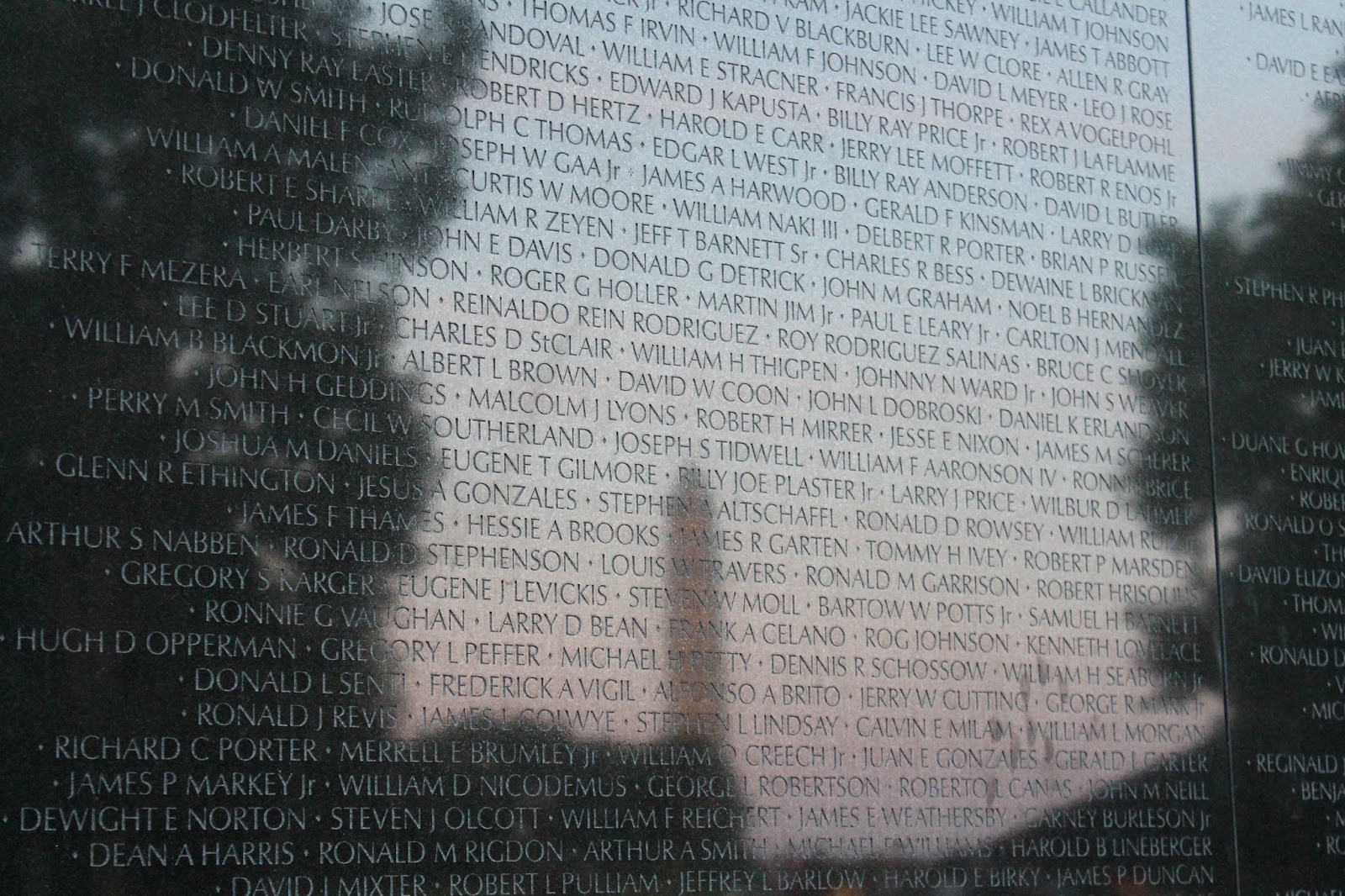
The reason for choosing that place is because my next event started right outside its doors. I had reserved an evening Capitol/Monument bike tour, but since I was the only one who signed up, they switched me to the Monument tour that started a half-hour later. Same price, though I think more monuments. At 6:30 about 15 of us followed our guide to the Ellipse to see the White House. Then it was on to the Washington Monument and memorials: the WWII Memorial and Vietnam Memorial (with a reflection of the Washington Monument).


On to the Lincoln Memorial (pretty sunset while there though the photo is of Abe)


On to the Korean Memorial (didn't photograph well in the dark), MLK Memorial and FDR Memorial. This photo is of one of FDR's sayings carved into the wall. Still appropriate today, alas.


We finished at the Jefferson Memorial. It was after 9:45 when we returned to the rental place.


Monday, August 26
I found the deli on the other side of the circle across from the hotel works quite well for breakfast, at a third of the cost.

The first big event of the day was the Capitol.


When I arrived at the Visitor Center one of the guides directing traffic asked if I had a reservation. I did, for 40 minutes later. He asked if I would prefer to take a tour in 10 minutes. Fine with me. So, he said, hide your reservation and go up to the counter and ask for the next tour. Tours are free. After I made my reservation more than a month ago someone declared me lucky and wondered how I did it. Just went to the Capitol website and got one. I guess the time to visit is late August.

Compared to the last time I visited the Capitol – back in 1974 – this tour was quite skimpy. We saw the crypt (where Washington was supposed to be buried but wasn't), the Rotunda, and Statuary Hall. That was it.

Each state may send two statues to the Capitol. A few more statues are ones that Congress itself chooses (such as the one of MLK). I saw one from Michigan – President Ford – and learned the other is Lewis Cass. Some of the others were ones I didn't expect. Such as Alabama honoring Helen Keller


And Montana honoring the only woman in the Senate in 1941 who was the only no vote when the Senate approved going to war in WWII. I think the name is Jeanette Rankin.


My favorite is Jack Swigert, astronaut from Colorado, who was elected to Congress, but apparently died before taking his seat.


I had lunch in the Visitor Center restaurant, which was good, but pricy for cafeteria fare. Then I spent time in the Exhibition Hall with a history of the Capitol and some of the major events in it. The last thing I did was a tour of the Bermidi Corridors. These are corridors under the current Senate chamber, painted by the same guy who painted the dome in the Rotunda.


From the Capitol I took the tunnel to the Library of Congress, which allowed me to not have to go through security again. That got me thinking about something others have said. Why is it if Congressmen think that concealed weapons are a good idea in most public places they take great pains to make sure they aren't in public buildings in DC? Is it because the crazies might be shooting at them? Then why is it OK to allow the crazies to be shooting as us?

I was in the Jefferson building of the Library of Congress. It is one of three buildings near each other and another 2 out of town. It is the most beautiful and biggest library in the world with more than 100 million items (not just books) with 22,000 arriving every day from around the world (of which they keep 10,000, the rest are donated to other libraries). One learns cool things when one takes the tour.

The LoC is working mighty hard, she said, to digitize its collection. Alas, if they are receiving 10,000 items a day but digitizing less than 10,000 a day you can guess how soon they'll finish.

As for the beauty...

The main hall.


The Reading Room.


I asked the tour guide how do they get 22,000 items a day? Some of the things they search for and specifically buy, some are daily submissions (like newspapers), and some are sent because LoC runs the copyright system and publishers send stuff to prove copyright. Some of that is kept, some is recorded and donated.

Which got me wondering. I compose for handbells and have a few things published. Might my publishers submitted my work to the LoC and might it be in their stacks, or at least in their database? So I asked the tour guide how I might find out. Look for it on loc.gov, she said.

So I did just now. Alas, no matches, though I also searched for handbell music in general. Lots of entries came up, even lots of composers came up (many names look familiar), but nothing for me. A good part of that is because with changes in copyright laws something is copyrighted as soon as it is created and one no longer has to file with the LoC to prove it. So I and my publishers don't bother with the expense.

I walked around outside the Capitol a bit, even though my feet were aching, then on to Union Station to get the Metro to Chinatown. Supper there was in a small place and quite good. Another Metro ride to the station closest to my hotel, which is also pretty close to the White House. So I took a moment to wander through Lafayette Park. Lots of people taking pictures, only a couple lone protesters.


Two days into the vacation and I've already finished a book. It is The Pun Also Rises. by John Pollack. It delves into the definition of a pun and examples of various types. He examines how the brain works and how the brain works on puns. Then it is on to a history of the English language and the role puns played. Around the time of Shakespeare puns were seen as a sign of intellect. Alas, a couple hundred years later they fell out of favor. Today, puns are a strong force in product marketing (I've seen the hair salon in Detroit with the name “Curl up and dye”). Then there is a perusal of puns across time and languages. And finally, a strong defense of the pun. The mental processes that make puns possible are the same processes used in creativity. So there. Of course, the author tosses in generous handfuls of puns as he explains things.

Tuesday, November 18, 2008

Power to the little guy

The current estimate is that there were gay marriage protests in 300 cities!

The ineffectiveness of the big gay rights organizations, our defeat at the polls, the anger gays now feel, the power of the internet, and the size of last Saturday's nationwide protests may spell the end of those big organizations. Saturday's protests were not organized by the big guys, but by grass-roots activists and the web. They achieved more in a few days than the big groups have managed in years. We now have the ability to go around the gatekeepers and do it ourselves.