Friday, August 14, 2026
Stories of my travels
I’m home. My travels (for now) are done.
The primary purpose of the trip was to attend another International Handbell Symposium. This is the 15th of these I’ve attended. This one was held in Aberdeen, Scotland.
I flew from Detroit to Amsterdam to Edinburgh. Because I didn’t want to rent a car I took the train up to Perth for a couple nights. One reason for stopping there is it is the closest rail station to the town of Rattray, the ancestral home of my sister-in-law who died five years ago. The town still has residents, a high school, and a community center, but its small commercial district is all boarded up. That’s not a big deal because there is another town across the river and its downtown is doing reasonably well.
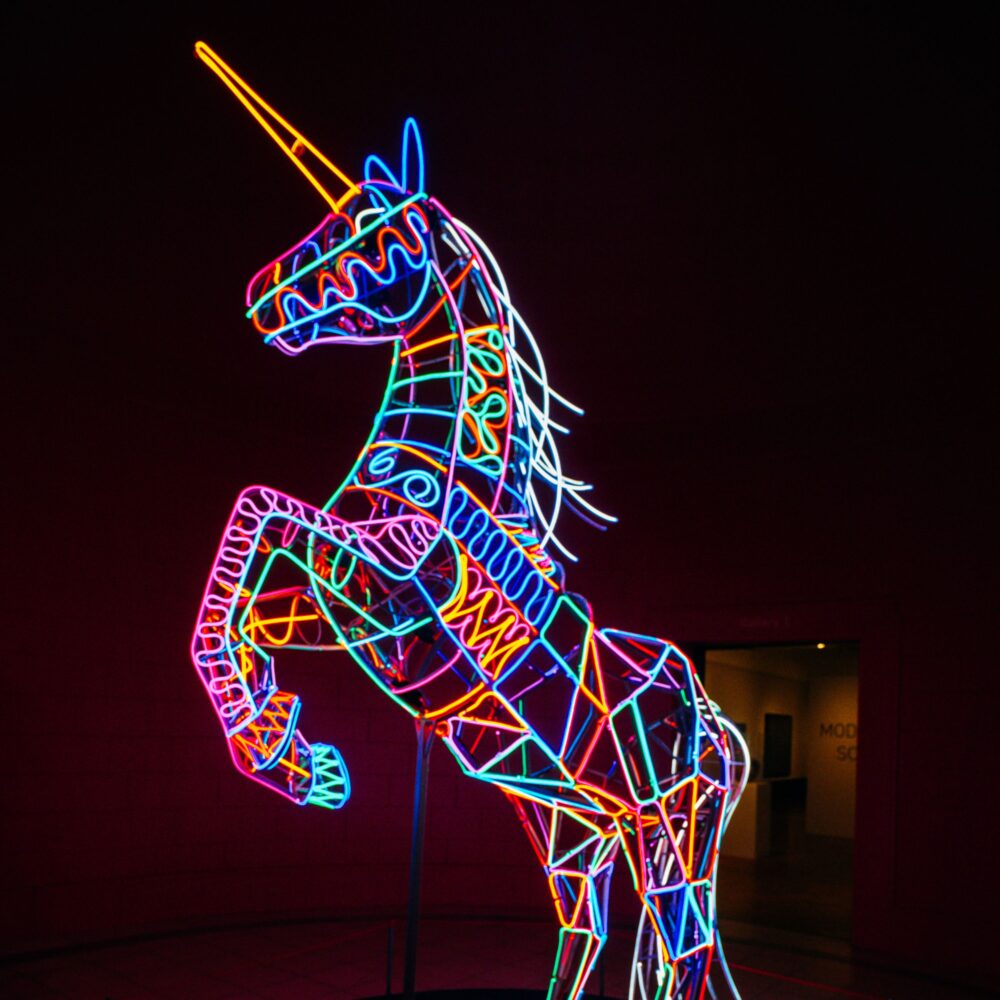
Back in Perth I visited the Perth Museum. It houses the Stone of Scone which is placed under the throne when a Scottish monarch is coronated. Since Charles III is king over the Scots (as well as the rest of Britain) the stone was there. I also visited the Perth Art Museum, which includes a neon unicorn.
I took the train up to Aberdeen. The convention center is in a business park adjacent to the airport. So there are hotels nearby. But there aren’t any supporting amenities, such as a laundromat.
There were over 600 ringers from 15 countries who formed one massive bell choir. We had nine directors from eight countries, each one leading one piece. In addition to spending a lot of time rehearsing the music we had classes in various aspects of handbells and in the culture of various participants. One class was about the Scottish tartan and kilt (no, I didn’t try one on). Another class was about Canadian folksongs arranged for bells and yet another about excerpts of a Hungarian operetta arranged for bells.
After the Symposium I spent three nights in Inverness. I took one day trip to Loch Ness and Urquhart Castle and another trip to Dunrobin Castle, which featured demonstrations of hunting by hawk and falcon.
I’ve been traveling for many decades. For my first trips I carried travelers checks. For this trip I used my credit card for nearly everything, even for many small purchases. For my time in Aberdeen some type of card or payment system was required because both the convention center’s coffee vendors (which I skipped) and the hotel were cashless.
I found I had to be careful in some places because they offered to let me pay in dollars instead of pounds. I first thought this would be good because I could skip my card’s 1% foreign currency fee. But after doing it once I found out the business charged a 3% fee for allowing me to pay in dollars.
I had withdrawn £50 when I got to Perth. I used my card so much that when I was back to the airport I still had a £20 bill. And the currency exchange at the airport charge a huge commission. Maybe during my next foreign trip I don’t use the ATM at all.
On the flight to Europe I watched the documentary Paris is Burning about the black queer ball scene. I wanted to watch it because the youth at the Ruth Ellis Center in Detroit would imitate such balls. Preparing and participating in a ball could give a young queer person a chance to develop confidence and charisma. All that is good. Alas, by halfway through (and it isn’t very long) I was bored. I did finish it. Instead of watching anything else I tried to get some sleep.
On the flight back to Detroit I watched two movies and had time for a third. On the way east I spotted a couple interesting movies, but they weren’t available on the return flight. I did see a couple Disney movies. The first was Zootopia 2 in which cops Nick the fox and Judy the rabbit solve another case. This one plays on the idea that we readily believe that snakes would be the villains. I enjoyed the story and the emphasis on inclusion.
The second movie was Hoppers. A hopper is a mind that has been transferred into mechanical robot. The primary hopper is Mabel. Her grandmother introduced her to the glen around a beaver pond. Now with Mabel in college, Jerry the mayor wants to run a highway through the glen. Mabel, transferred to a beaver robot and able to hear what the animals are saying, works to rouse the other animals to stop him. It’s all great fun, though some a bit over the top (such as seagulls flying a shark through the air to terrorize Jerry), and there’s a good message about inclusiveness and the importance of wild spaces.
Before the trip I finished the book Dust Child by Nguyễn Phan Quễ Mai (those diacritical marks are so important!). Part of the setting is the Vietnam War and a dust child is an Amerasian child of a Vietnamese woman and an American soldier, considered by society to be nothing but dust.
The story follows several threads. There is Phong, a dust child whose life is made worse because his American father was black. Phong sticks out because of his dark skin and that he is so much taller than the typical Vietnamese. Because of that he is bullied. In 2016 he is trying to immigrate to America with his wife and children. But he was the victim in a fraudulent previous attempt to immigrate and is refused.
Another major thread in the story is Dan, an American suffering from PTSD from the war. His wife Linda hopes a trip to Vietnam will resolve some of his traumas. He wants to find Kim, the Vietnamese girl he fell in love with during his tour in 1969. Linda doesn’t know about her and doesn’t want to lose her. When Kim became pregnant he got scared. By that point he was beginning to suffer from PTSD. He wonders what happened to her child.
After being introduced to Dan in chapter 2 I thought these two threads are too convenient. But Dan is white and not the father of Phong.
A third thread is Trang. In 1969 she worked at a bar catering to soldiers and took the name Kim to protect her family. She shows us how she and her sister chose to leave their village to work in a bar in Saigon. The short answer is their parents were in debt and an old friend visits, explaining how she is able to dress well.
At times I felt the author was not a great wordsmith. But she tells a great story and she does not allow her characters the easy way out. They have to grapple with the issues. One of those is the Amerasian children telling their elders: Did you really have no choice other than to leave me in an orphanage? Why did you wait so long to search for me?
In an author’s note she explains that she got involved in an organization that worked to unite Amerasian children with their American fathers. She heard a lot of stories of what the children and soldiers went through. Though the book is fiction the characters are based on the stories she heard.
I enjoyed this one very much and recommend it.
While traveling I finished three books.
A Walk in the Park by Kevin Fedarko. In America that phrase means something is very easy. While the title is accurate it is full of irony as the subtitle shows: The True Story of a Spectacular Misadventure in the Grand Canyon. Walking that park is not easy and can be quite dangerous.
Fedarko (the book refers everyone by their first name, so I’ll do that too – this is Kevin) is a freelance writer. One day he visited a company that does boat tours running the length of the canyon. He was so entranced by the boats and the idea he volunteered to join the crew for that summer and several summers after that. Volunteering means he never got paid. He also was never good enough to be in charge of a boat or have paying customers in his raft – so he hauled equipment.
A few years into that he met Pete McBride, a freelance photographer. Pete proposed they team up and they became good friends. But Pete did very little planning for his photography trips which sometimes meant what he came to photograph didn’t happen at the time he was there.
When Pete proposed they hike the canyon from one end to the other Kevin, who had seen the canyon only from the rim and the river, was all in. They got in touch with Rich Rudow, a veteran canyon hiker and explorer, who with a few friends was planning to hike the whole canyon. Pete sweet talked their way onto this team, though Rich’s crew were planning and training carefully and Pete bragged the trip could be done straight “off the couch.”
Pete and Kevin tried to take a great deal of equipment they didn’t need – including Pete wanting duplicates of his extensive camera equipment – and refused many things Rich and team considered essential.
The Grand Canyon does not have a paved trail from end to end, and for much of the way there is no marked trail. One must forge their own path, sometimes hiking close to the rim, sometimes close to the river, and the canyon walls between can be thousands of feet tall and steep. In the summer the temperature can be brutally hot and water can be scarce. One misstep and a person can slip right over the edge. This is not a place for amateur hikers. Which Pete and Kevin were.
So, yeah, the first section of the hike did not go well. Once they were pulled off the trail some of Rich’s friends took over their training and some went with them when they began their second section. And – eventually – Kevin and Pete do hike the entire length.
Along the way Kevin learns from Rich about notable people who have explored they canyon. Those stories are included. When Kevin encounters pottery fragments he begins to understand Native people lived in the canyon up until white people kicked them out. Rich arranges for Kevin to meet Natives working to reclaim some of their land, others working to prevent developers from despoiling the canyon, and yet more who are profiting from the canyon. Kevin is clearly on their side.
Because the first part of the trip went so badly, by the end Kevin wonders why didn’t Rich refuse to take them on? Why did Rich’s friends willingly train and accompany them?
I quite enjoyed Kevin’s story and he is a good writer. Because of what he learns about himself, the canyon, and the millions who visit it this book gets a high recommendation.
Guests of War by Robin Jenkins. He is a well known Scottish author. I bought the book in Scotland. It was first published in 1956 and reprinted this year. At the start of WWII the British Prime Minister told Hitler that if Poland was invaded Britain would declare war. At that time the British government instituted a program where residents, at least the women and children, of cities likely to be bombed were evacuated to rural areas. So the profoundly poor residents of the (fictional) district of Gowburgh in Glasgow were evacuated to the (fictional) well off community of Langrigg.
I expected there would be a lot of conflict between the rich and the poor. There is some of that, but less than I expected. For the most part the villagers opened their homes and otherwise supplied their visitors with needed things.
One component in the story is the incompetence of the leadership in both locales. They think certain operations must be done in a particular way, and aren’t willing to be flexible when those plans are shown to be unworkable. An example was the demand that all incoming children be inspected for lice, a process that takes way too long when there are hundreds of children. Besides the kids were inspected before they got on the train. Also, assuming that all the kids from the poor neighborhood had lice was a form of discrimination.
A forward says the real evacuations usually weren’t planned well. Some of the evacuation trains were woefully short on food.
Several women with a large number of children couldn’t be placed in private homes so a quite large estate was opened for them to live together. A woman of the Langrigg city council was sure the poor families would turn the place into a slum – which didn’t happen.
A woman of Gowburgh considered herself to be too important to be from that place. She complained her husband, a barber, didn’t make enough money and offered to trim the hair of homeless people. How could he lower himself! She demanded special accommodations for her children because her son would, of course, grow up to be a famous doctor. Not just the people of the rich town could be snooty. I enjoyed the book.
The third book was Alas, Babylon by Pat Frank and published in 1959. At that time in history, just after Sputnik, there was a “missile gap” in which the USSR had better and more long-range nuclear missiles than the US did. What if the USSR relied on that gap to launch a nuclear war against the US?
The first section of the book is leading up to the war. Randy lives in central Florida, north of Orlando. His brother Mark is a colonel in the Strategic Air Command and sends Randy a telegram saying he is sending his wife and kids to live with Randy and ends with the phrase, “Alas, Babylon.” The phrase had been used by a fire-and-brimstone preacher and the brothers adopted it as a way for Mark to tell Randy that the ultimate war was about to start.
The nukes hit Miami, Orlando, Tampa, and Jacksonville as well as many other cities and military bases across the country. Randy’s home and town escapes the fallout. Soon residents clear out local stores of all provisions. The dollar can’t buy anything so becomes worthless. The banking system collapses as does communications. Electricity was supplied by Orlando, so that ends.
Randy and his small community (including an extended black family) do decently because they live on a river and can fish for food, they have communal access to an artesian well, they have orange groves and gardens, and several of them are proficient with tools and mechanical things.
Frank’s message is even with such a calamity humanity will survive. Returning from such a huge technological setback may take decades to centuries, but will happen. In a forward by David Brin, author of a similar post apocalypse story The Postman (which I’ve read and enjoyed, but skip the movie), he says a big difference between Frank’s story and many others like it is that Frank offers hope.
But even if great number survive a nuclear war will be devastating to millions of people.
I enjoyed the book. There were scenes of the characters faced with the latest crisis balanced with scenes of tenderness. It’s a good one.
I stayed up last night to my usual bedtime, though it was about 3am in the time zone I woke up in. Then I woke up at 4am Detroit time. I seem to get over jet lag when I leave home, no matter whether I fly east or west. But once home recovery takes longer.

Subscribe to:
Posts (Atom)