skip to main |
skip to sidebar
How pervasively patriarchy distorts and messes up life
I finished the book My Three Dads, Patriarchy on the Great Plains by Jessa Crispin. This isn’t about three men who nurtured her as a child and guided her as an adult. These are three men who represent aspects of patriarchy. The book is about Crispin coming to terms with the extensive impact of patriarchy on her and the society around her (primarily in Kansas). It is a scathing indictment.
The first of the three men was a respected member of the community who one day killed his wife, children, and then himself. Cripsin was amazed how thoroughly fascinated the people in Kansas were of the deaths and how they tried to excuse the killer.
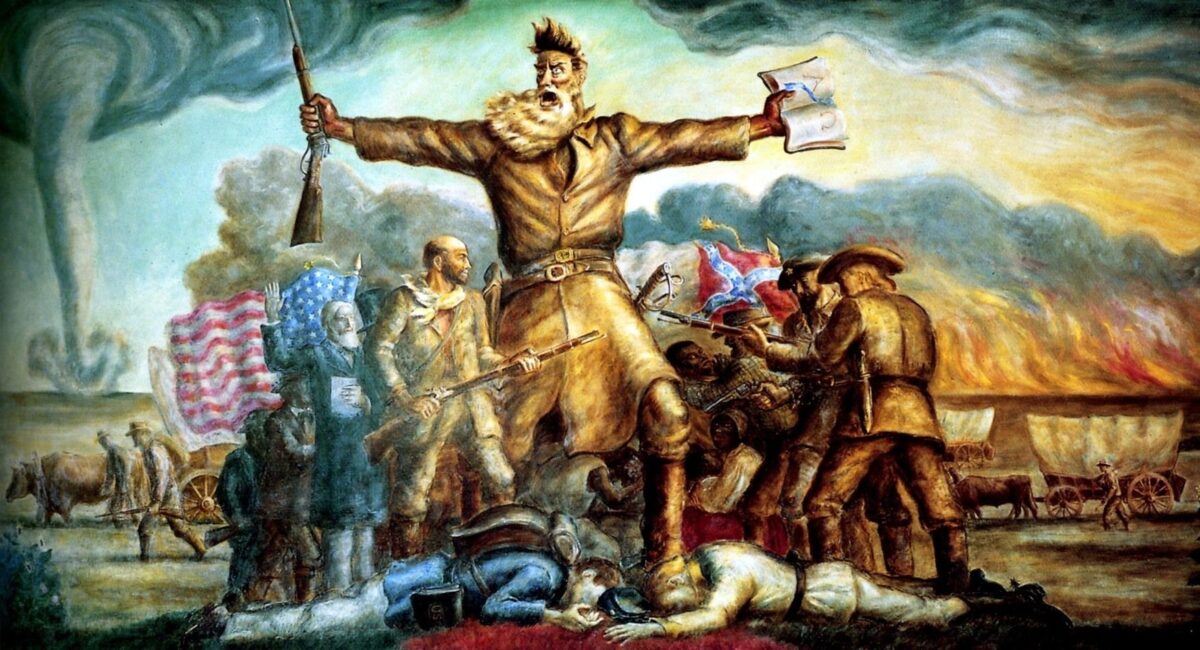
The second was John Brown, famous for his actions leading up to the Civil War. He and his sons also were involved in the abolitionist movement in Kansas and are commemorated in a big mural in the state capitol in Topeka. I found a photo of it here. Crispin wonders why violent men are praised so highly.
The third was Martin Luther, the guy who prompted the Protestant Reformation. Crispin thinks he said some great things for life without patriarchy, but then instituted things to do the opposite. And those actions prompted the Protestant work ethic, which prompted capitalism to be rapacious. We are suffering from that now.
I kept this book in the car, so read it while I had to wait for something. When I came across an interesting passage I wrote down the page number. So here are some of the interesting bits, a few of them I read several months ago.
From the first section:
Why do we organize our societies around the nuclear family? It seems to be killing us. Why haven’t we come up with a better structure? Why should this unit be considered fully functional and productive? Why do we consider any other arrangement to be temporary, waiting for marriage to come along? “Marriage is an instant structure to lock yourself into.” You announce your role to the community when you declare you’re a wife, husband, mother, or father and society won’t let you deviate from it.
Beguinages existed in Europe before the Reformation. They were an area, perhaps an independent city, made up of only women. There were two options for women at the time. One was be a part of a family, in which she cycled through pregnancy, childbirth, and post birth with a very high chance of dying young because of one of the three. Or she gave herself to the church and was removed from the world. A beguinage offered a third choice in which women lived in community. The women were interdependent, but could determine their own role in the community. The beguinages were shut down after the Reformation because Protestants didn’t want a place for women outside of the family.
Crispin discusses utopias, then asks what do we do with the assholes? Mass incarceration hasn’t prevented the creation of new criminals. Part of the problem is the designers of utopias want a homogeneous place built around a political idealism. But Crispin says that’s boring. She wants a place that includes everyone – those on the margins, the screwups, the unlovable, the misfits, and losers. Think of how care needs to be reorganized to bring them all in so they could live with dignity, but also so that one part of the community is not burdened with the caretaking.
Before we think about what is owed us we must think about what we owe each other. That runs against those who have been in long fights for equality. Those struggles prompt a victim mentality and that we need protection. But we think the best form of protection is control and the oppressed become oppressors.
We need a definition of community that is more than people who I should care for and who is not worth my care. It can’t be groups that share a common trait or income status. It can’t be defined by like minded people who shut out dissent.
From the second section:
Kansas does live in the lineage of John Brown, but for a different reasons that what is claimed. His influence is felt in this state in the persistent belief that if you are certain about an issue and you believe yourself to be righteous, you are permitted to attempt to reshape the world with violence and bloodshed. All you need to live out god’s plan is a gun.
...
One of the reasons these issues become intractable is that people have so little awareness as to the roots of their political beliefs. Unable to separate out politics from self-interest ... they obfuscate and dodge and self-deceive. Tracing a political stance all the way to its source, whether that is religion or values or experience, is an act of self-interrogation few people are willing to undertake.
The purpose of the counterculture is to give a person a place to land when they realize our society is sick, poisoned by corporate culture, and made empty by shopping and social media. But we’ve abandoned that.
The left criticizes culture – they theorize and speculate, but don’t engage and build. But the right understands that everyone needs personal recognition, especially when community breaks down. Each person needs to be seen and understood as something more than identity markers and the stereotypes that come from that. The right amps up that need, saying you are not only seen, but superior. You get an instant community and an instant story of how the world works. “White nationalists are extremely good at showing up for one another and providing support.” That story blames Jews and liberals. “For a very long time, a small segment of our population avoided self-knowledge by asserting dominance. ... The dominant segment kept this system in place by basically refusing to allow anyone else to insist on their own reality.” The silence has been broken and one can read accounts of the lives of minorities.
Crispin turns to mass killings. She wrote, “Violence can be a tool of the oppressed, but only if it is surgical. To take a life does too much to the human spirit, if humanity remains within the killer.” As one who believes the only purpose of violence is to cause oppression that’s a radical statement. But it does make some sense. Killing a person who is about to cause harm to a great number of people does lessen oppression.
But there are problems. First, most of the killers, mass or not, don’t target a person who is about to cause harm. They just point the gun and shoot. The oppression they intend to lessen remains. Second, when police subdue a person they believe is about to cause harm, they are frequently wrong in that belief and kill an innocent person. Third, as Crispin says, taking another person’s life harms the spirit and humanity of the killer, even to the point of destroying both.
Crispin then discussed Janet Reno and the attack she ordered on the Branch Davidian complex in Waco, Texas. Crispin mentions that there may have been distasteful practices inside the compound (I can’t get into details), but the actions did not warrant the government’s attack on the complex, especially since it killed the children Reno claimed to want to protect.
One observer of the debacle was Timothy McVeigh, the guy who bombed the federal building in Oklahoma City two years later. Crispin draws a direct connection on how the government’s action prompted McVeigh’s response.
Crispin’s cousin was a missionary and appealed to her for funding. The whole concept seemed bizarre and stupid to her. Why do we insist unity and equality means we must all think alike?
So much harder to treat the world as a garden. To weed rather than raze. To nurture rather than handle. To compost rather than pave over. To encourage rather that twist. To suggest rather than insist. To tend rather than master. To encourage variety rather than monoculture. To allow frivolity instead of utility. To observe and delight rather than intervene. To be humble and questioning rather than certain.
All people who promote their way of life as the only correct way and all other ways are dangerous and must be eliminated – Crispin considers them to be missionaries. These people are afraid of how they will be treated, so want to control it. Instead of being kind they want to enforce behavior that looks like kindness.
From the third section:
Crispin discussed the thousand Protestant denominations. Each one believes they read the Bible and discerned the original intention. Each one says they are right and all the others are wrong.
In this case, I have a small issue with Crispin. When John Wesley founded Methodism, it wasn’t to start a new denomination, it was to reform the Anglican Church, which really had strayed from the original intention of the Bible. Alas, over the centuries Methodism has also strayed from the Bible’s original intention – see the recent split of the United Methodist Church over how LGBTQ people are to be treated. I can’t yet say that after the more conservative congregations split away the UMC is back on track.
Crispin noted that these thousand Protestant denominations is not proof of Christianity’s creativity, durability, or universality. It only means people are very good at turning “God into a gimmick.” That the Bible can be used to both embrace poverty and declare God blesses us through riches only means that “all churches have corrupted and twisted and misinterpreted some aspect of Christ’s thoughts.”
So start your own church! Correct all the errors of the past! But your followers or descendants will just mess it up. Crispin rather likes Wesley – but sees little of him in the churches that follow his tradition.
In a few pages I can’t reproduce how pervasively patriarchy influences, distorts, and messes up life in America and across the world. Patriarchy needs to be rooted out, but Crispin shows how close to impossible that effort would be. A big reason is, of course, dealing with all the men who feel they benefit from patriarchy and will work long and hard to preserve it. Our culture, and the cultures of the world, are so corrupted by patriarchy that we all suffer great mental health problems and most of us don’t recognize the problems.
This book isn’t all that enjoyable, though I found it fascinating. However, it is an important book and I highly recommend everyone read it.

No comments:
Post a Comment