Showing posts with label American Travel. Show all posts

Thursday, October 9, 2025

Make resistance the safer bet

I finished the book Whistle-Stop Politics; Campaign Trains and the Reporters Who Covered Them by Edward Segal. The book is small scenes of when a politician climbs onto a train to take his message to the small towns across the country. Segal was the press secretary for an Oklahoman Congressman in 1984 and thought to use a campaign train to introduce his candidate to more of the state. He wanted to find a book or other resource about campaign trains and came up empty. So he started collecting stories, then did serious research, and 40 years later produced this book. Overall, it’s a lightweight book. He covers the campaigns from the late 1800s to Biden’s train in 2020, though the first train campaign was in 1836. Th coverage isn’t of the type of saying in 1896 this candidate was on the rails for this number of days, covered so many miles, gave this number of speeches, had these incidents along the way, and the trip had this consequence for the candidate or the future of campaign trains. Instead, the book is organized by topic. These campaigns had this type of incident. These had that type of incident. Each incident is described in a few paragraphs, up to a page or two. Campaigns can appear under several topics, but there isn’t a complete campaign narrative. Some of the topics: A description of the campaign train (the candidate’s car was always the last one and out its back door was the campaign platform). Who was on it (candidate, staff, reporters, regular train staff). Whether the candidate gave the same speech at every stop or how he pulled in local details. What local politicians were introduced. How the logistics of the trip were set up. What the Secret Service did to make the route safe. What happened when a doctor was needed. How the candidate dealt with hecklers or protesters. How the press managed enroute (no showers, no laundry, no direct communication while on the train). As to the last topic, occasionally the train stopped and everyone stayed at a hotel. Sometimes they stopped only during the day, so the hotel would get a request for six rooms and 150 towels. Segal also described some campaign imitators. In 1940 Gracie Allen of the comedy team Burns and Allen did a train tour as the candidate for the Surprise Party. Winnie the Pooh did one in 1972 with advisors Tigger and Eeyore. Mickey Mouse did one in 1978 to celebrate his 50th birthday. The top candidates that logged the most miles on a train were Franklin Roosevelt and Harry Truman, far more than any of the others. There is a description of the rail car built for Roosevelt to keep him comfortable and safe. The reason for campaigning by train was simple: There was a train depots downtown in practically every small city. Everyone knew where it was. The airport, if there was one, was a ways outside of town and few people knew about it. A train allowed the candidate get close to the people. I enjoyed the book, but glad it was just over 200 pages (plus 778 endnotes to list the sources that I could skip) and I could finish it in just a few days. As I said, these were short amusing stories without a comprehensive narrative. Oliver Willis of Daily Kos reported on Monday the nasty guy’s invasion of Chicago has begun. It’s over the objection of Gov. JB Pritzker and the city’s mayor. The justification for sending in the troops is, of course, lies. Also on Monday Lisa Needham of Kos reported on the state of the invasion of Portland. U.S. District Court Judge Karin Immergut ruled on Saturday that the nasty guy could not federalize the Oregon National Guard to protect federal agents in Portland. On Sunday the judge ruled that the nasty guy could not use California’s national guard protect federal agents in Portland. That ruling was at the request of both California and Oregon because neither wanted one state to invade the other. While she was at it the judge ruled the nasty guy couldn’t use the national guard from any other state either, even if Texas was offering. The case was appealed and I’m still behind in my reading. A week ago Needham reported that the nasty guy has a new effort to get colleges and universities to bend to his will. He came up with a ten point plan titled “Compact for Academic Excellence in Higher Education.” Schools that agree to it will get preferential access to federal funds. Needham wrote about the points in the plan. Here’s some of them.
So a vibrant marketplace of ideas, but one where schools put their thumb on the scale for conservatives, who basically can’t compete in the marketplace of ideas in higher education. ...And, of course, there are demands that there be no race-or sex-based preferences in hiring and that transgender women be barred from women’s locker rooms and sports.
And they need to hire an independent auditor to ensure compliance.
So all that schools need to do to get “multiple positive benefits,” including “substantial and meaningful federal grants,” is to totally alter their curriculum, departments, admissions, hiring, and sports teams to conform to whatever racist, transphobic, or xenophobic thought that skitters across Trump’s gray matter at any given time. Just some minor tweaks, really.
Nine schools have received the “invitation.” One, the University of Texas at Austin, appears all in. On Monday Dalbert of the Kos community reported that Gov. Gavin Newsom of California has a response. Refuse the nasty guy’s offer a school could lose federal funding. But if a state school accepts the nasty guy’s offer they lose state funding, including grants to California students.
People cave to bullies when there’s no cost to giving in. Newsom’s changing that dynamic. The article urges other blue-state governors to follow suit: cut off state resources to institutions and officials who comply with Trump’s demands. Make resistance the safer bet.
Alix Breeden of Kos wrote that a few top level comedians have gotten themselves into a mess. The royal family of Saudi Arabia funded the Riyadh Comedy Festival. The royal money means they paid big bucks to the comedians, like $375K and upwards. They are working hard to burnish their image. With this royal family we know there is a catch – the entertainers signed contracts specifying they would say nothing bad about the country, the royals, the legal system, or the religion. But giving up free speech for a paycheck, especially a big one, means they are losing credibility in America, especially after Jimmy Kimmel was pulled off the air because of free speech. Fellow comedians are saying their hypocrisy is showing. In the comments of Monday’s pundit roundup for Kos paulpro posted a cartoon by Angel Boligan showing the nasty guy beating furiously at a huge drum set while the two speakers are aimed at earth. John Sipher posted a cartoon by Kal showing a big beefy American army man ready to fight foreign foes while a small Pete Hegseth tugs at his ankle and points to a cat named “Wokeness” and saying “You’re under attack!” In Tuesday’s roundup Chitown Kev quoted Paul Krugman writing for his Substack on why the nasty guy’s second term seems to have gotten so extreme so fast.
One reason things have gotten so extreme, so fast may be that Trump, Miller and company are in a race against time. Foreign autocrats like Orban or Vladimir Putin could afford to chip away gradually at the foundations of democracy because they were, at least initially, quite popular. Trump — although he won’t admit it — has very low approval, and the public opposes him on every major issue. Yet he and his minions control much of the machinery of government, and are trying to use it to intimidate — you might say terrorize — their opponents before public anger catches up with them.
In the comments exlrrp posted a meme showing, I think, Press Secretary Karoline Leavitt. Whoever it is the text is fun. It says, “She’s going through the normal 5 stages of grief: pyrotechnics, merch, podcasting, grifting, and acceptance.” In the comments of Wednesday’s roundup is a cartoon posted by LJ Slater and created by Smit. It shows ICE agents standing around and one says, “I gotta leave early today, guys. We deported my kid’s babysitter.” A comment posted by paulpro shows a calm Chicago scene and two ICE agents are talking:
First: You see any Chicago Antifa rioters yet? Second: No, but there was a dress sale at the Water Tower my wife would kill for.
LJ Slater posted a cartoon by David Cohen. It shows a peace prize on the floor and the nasty guy reaching for it. To the side one guy tells another. “It’s an old bar trick. I glued it to the floor. Let’s see how long it takes him to get it.” In the comments of today’s roundup Fiona Webster posted a cartoon by Jesse Duquette showing a policeman cuffing a young black child (I’ve seen mentions that this is a thing). The policeman says, “Stop crying. America’s great now.” Webster also posted a cartoon by Lalo Alcaraz that has a caption, “Meanwhile, at the border... The president ordered that the border wall be painted black because it makes the wall hotter when migrants climb it. Also, it’s lunchtime.” The image shows the bottom of three beams of the wall bent up and being used as a grill attended by a Mexican man. Beside him is a sign, “Hot border tacos.” While checking one set of stats for this blog – the excitement of setting big viewing records in September – I forgot to keep track of other stats. I’ve passed mentioning the nasty guy in 700 posts, this one is 701. There are only two topics with more posts. One is “GOP” which is now at 1114 posts. The other is “Gay Marriage” and “Marriage Equality” (I switched tags) at 711.

Friday, August 1, 2025

The delusion that we could corral all the violence behind a fence

I’m home from my travels. I spent some time with a cousin west of Chicago. A strong storm came through, but not when I was driving. The Reconciling Ministries Network Convocation was held in Madison, Wisconsin. If I write about it, my report will be in a separate post. After Convo I took a tour of the Wisconsin State Capitol, a beautiful building. When in the Supreme Court chamber our guide noted this court has the reverse of what one might expect – of the seven justices there are six women and one man. On Monday I toured Taliesin, the home and studio of famous architect Frank Lloyd Wright. The buildings show off the style that made him an important figure in American architecture. The guide warned us that Lloyd Wright was about five foot six and built the house to his scale. Men who were six feet and taller had to be careful of their heads. Though the place is well thought out, he sometimes would just try something, willing to replace it if it didn’t work. One such project was an extension of his bedroom. Some important architectural people were coming in three weeks. He had his students do the work. The results looks quite good. But the foundation wasn’t done right and is crumbling. The preservation society that now owns the place may have to rebuild it soon. That bedroom extension is to the right behind the vines.
From there I drove to Dubuque, Iowa. When I was a child my family took long vacations – not so much in time (though the first was four weeks), but in distance. We were also ones trying to claim we had been in as many states as possible. So on one trip we cut a corner of Arkansas and in another we crossed a corner of Iowa. I’ve also seen small bits of South Carolina, Delaware, and Georgia (never left the Atlanta airport while on the ground). I haven’t been to North Dakota at all. So this was a chance to see a *bit* more than a corner of Iowa. In Dubuque I visited the National Mississippi River Museum and Aquarium, which is pretty cool. The place includes the ship the William M. Black, which had been used to dredge the Missouri River. It did that by shooting water into the channel and sucking up the sediment that had been stirred up. Their special exhibit was some of the feathered dinosaurs that had been found in Alaska (cool, but not sure what that had to do with US rivers). I took the Fenelon Place Elevator up the bluff to have a great view of the town and river. This “elevator” might better be known as a funicular or an inclined railway. This one is the shortest and steepest of the kind.
I learned the way to easily find Dubuque on a map. The bridge across the Mississippi at the north end of downtown crosses to Wisconsin. The one at the south end of downtown crosses to Illinois. From there I went to Davenport. Along the way I, of course, passed a lot of cornfields. But I was surprised at how hilly the countryside was. In Davenport I saw the German American Heritage Center and Museum. It has displays about the German immigrant experience – why they left Germany and what they did once they came to America – from about 1850 to 1925. My mother’s ancestors came from Germany between 1830 and 1870 and settled in Missouri. A few things I learned: I think it was the 1910 census that showed over 30% of residents of the Upper Midwest were from Germany. Several other states had German populations of more than 20%. Since the German population was so large they tended to continue speaking German for generations. They formed several types of social or community clubs to promote arts, fitness, and civic life. While other Americans at the time considered music to be an activity of the home, Germans considered music to be a community activity. They formed community bands and choirs. They continued speaking German until 1917, when the US went to war against Germany. Starting then schools would only teach English. Public discourse was only in English. German newspapers went out of business. On Wednesday I made the trip home. I left at about 7:20 am, just as a thunderstorm was hitting Davenport. I soon got ahead of it. I followed I-80 across Illinois and much of Indiana. There was a long construction zone around Joliet, though the traffic kept moving. South of Chicago and into Indiana there were two long sections of stop-and-go traffic. One didn’t have an obvious cause. The other was because an accident squeezed five lanes of traffic down to two. From the start of the first to the end of the second I did 22 miles in 75 minutes instead of the expected 20 minutes. All that put me into the Detroit area and its own backups at rush hour. I stopped to buy food and pulled into my garage as it started to rain. During my travels I finished the book The Road to Roswell, a novel by Connie Willis. Francie goes to Roswell, New Mexico, to be the bridesmaid for her college roommate. The wedding is to be held in Roswell and its UFO Museum during the UFO festival because all involved (except Francie) are alien fanatics. These are hardcore people, especially the groom. Francie is quite annoyed with so much fanaticism. She wonders if she’s there to talk the bride out of the marriage, as she had done before. But it is Francie who is abducted by an alien. It does not look anything like the green humanoid with big eyes seen on posters around Roswell. It resembles instead a tumbleweed with lightning fast tentacles. The similarities to whips gives it the nickname Indy, for Indiana Jones. It demands Francie drive it to ... well, it isn’t sure where it wants to go. Along the way a few more people are abducted – Wade, who sells abduction insurance and way too freely admits to being a con man. Lyle, who spouts every alien conspiracy. Eula May, an elderly woman who is good at making money at casinos. And Joseph, an elderly man who happens to have a gigantic RV for all of them to live in. While Indy sends them back and forth across the Southwest they try to figure out how to communicate with their alien and to find out what Indy is looking for. It’s all great fun and is similar to the other lighthearted tales Willis has produced over the years. I enjoyed it. About the only articles I collected over the last few days are pundit roundups for Daily Kos. The roundups seem to cover the basic points. Wednesday’s roundup by Greg Dworkin quoted Elliott Morris and Mary Radcliffe of Strength in Numbers. The article notes that “The Democratic Party's net rating (-30) is 19 points below that of the Republican Party, and the WSJ’s worst-ever gap for Democrats.” That’s near historic lows. In an accompanying tweet Morris added “But the Dems are still leading polls for the House next year.” Back to the article:
These are some tough numbers for Democrats. But I think the collective freak-out over this one poll is unwarranted — and in general, I wonder if party favorability is telling us something all that useful or actionable anyway.
In the comments exlrrp posted a meme that touches on the latest bit of the Epstein scandal. The nasty guy complained that Epstein had “stolen” more than one of his employees who were underage girls.
Molesting Adolescent Girls Allowed Anti-drag laws have been introduced in AZ, AR, FL, ID, KS, KY, MO, MT, NE, OK, SC, TX, and WV to “protect kids.” Child marriage is legal in 12 of those 13 states.
Remember that hypocrisy is a declaration of strength – I can do things that I won’t let you do (even if my reasoning is illogical). In Thursday’s roundup Chitown Kev quoted Yuli Novak, the director of an Israeli human rights organization writing for the Guardian on why Israeli actions in Gaza are genocide.
Genocide does not happen without mass participation: a population that supports it, enables it or looks away. That is part of its tragedy. Almost no nation that has committed genocide understood, in real time, what it was doing. The story is always the same: self-defense, inevitability, the targets brought it on themselves. In Israel, the prevailing narrative insists this all began on 7 October, with Hamas’s massacre of civilians in southern Israel. That day was a true horror, a grotesque burst of human cruelty: civilians slaughtered, raped, taken hostage. A concentrated national trauma that summoned, for many Israelis, a profound sense of existential threat. But 7 October, while catalytic, was not enough on its own. Genocide requires conditions – decades of apartheid and occupation, of separation and dehumanization, of policies designed to sever our capacity for empathy. Gaza, sealed off from the world, became the apex of this architecture. Its people became abstractions, perpetual hostages in our imagination, subjects to bomb every few years, to kill by the hundreds or thousands, with no accountability. We knew more than 2 million people were living under siege. We knew about Hamas. We knew about the tunnels. In hindsight, we knew everything. Yet somehow we were incapable of understanding that some of them might find a way to break out. What happened on 7 October was not only a military failure. It was a collapse of our social imagination: the delusion that we could corral all the violence and despair behind a fence and live peacefully on our side. That rupture arrived under the most extreme rightwing government in Israel’s history, a coalition whose ministers openly fantasize about Gaza’s erasure. And so, in October 2023, every star in our darkest nightmare aligned.
In the comments are several notable memes posted by exlrrp. First:
Ghislaine asking SCOTUS to overturn her conviction should worry you because her family is wealthy and can pay for Thomas’ and Alito’s next vacations, get Kavanaugh a lifetime supply of beer, Amy Coney Barret some designer handmaids uniforms and pay Roberts to look the other way.
Right below that one:
And the simple, gut-wrenching truth here is this: No one cuts deals with monsters unless they are terrified of the truth those monsters could unleash. And no one empowers a trafficker – unless they have something they need to keep buried.
Further down but on the same topic:
Why was a 15-year-old working at an adult spa...owned by Donald Trump? There it is, folks. There. It. Is. The question they never want you to ask. The answer they’ll never be able to explain.
And a meme that shows a tweet from The Bulwark:
Q: “Would you support a pardon or commutation for Ghislaine Maxwell, a convicted sex trafficker?” Speaker Mike Johnson: “That’s a decision of the president...I won’t get in front of him, that’s not my lane.”
That’s followed by a tweet from Mehdi Hasan:
The Christian speaker of the House can’t bring himself to publicly oppose a pardon for one of the worst child sex traffickers of our lifetime. That’s the story. That should be the headline. Astonishing.
Yet another “scandal” is the revelation of evidence that the nasty guy consistently cheats at golf, the game for which he most frequently leaves the Oval Office. Rambler797 got into a discussion with exlrrp about it and Rambler797 wrote:
It’s an odd fixation, to so obviously fabricate something like a club championship. Compulsive need to be seen as a winner. Not to win, mind, but to be seen as a winner.
And in today’s roundup Dworkin quoted Liz Dye of Public Notice commenting on Epstein “stealing” underage girls from Mar-a-Lago. The nasty guy claims the “steal” ended his friendship with Epstein.
Jeffrey Epstein did not “steal” Virginia Giuffre — she was a 14-year-old girl, not a vassal on Trump’s estate. Giuffre was working as a spa attendant at Mar-a-Lago in 2000 when Maxwell picked her up and hired her as a “traveling masseuse.” And in any event, his timing doesn’t line up at all. As law Professor Ryan Goodman points out, two years later the bromance was still going strong, with Trump guffawing to New York Magazine that Epstein was a “terrific guy … a lot of fun to be with. It is even said that he likes beautiful women as much as I do, and many of them are on the younger side.” But Giuffre wasn’t laughing. She spent five years being abused by Maxwell and Epstein, and appears to have been haunted by the experience for the rest of her short life. She died by suicide just three months ago.
A 14-year-old working as a “masseuse”? Red flag right there. Dworkin quoted David Shuster of BlueAmp. Just before most of Dworkin’s quotes there is a summary sentence I assume Dworkin wrote. I usually ignore them, but this one is quite good.
A man so pathetic, so filled with self-loathing, envy, jealousy, such a Grand Canyon of emptiness inside, he's President of the United States and still has to cheat at golf.
The quote from Shuster:
Let’s be clear. The game of golf, admittedly a pastime for the idle rich, is governed by a code of honor. A golfer keeps his or her own score and plays the ball where it lies. A true golfer does not helicopter into the rough, kick his ball back onto the fairway with the discretion of a Clydesdale, and then claim a birdie with the sanctimony of a choirboy. But truth and Donald Trump have never been close enough to be a golf pairing. A few years ago, Sportswriter Rick Reilly wrote a book titled “Commander in Cheat”— based on the author’s interviews with Trump caddies. Trump’s own employees noted Trump cheats all the time and said Trump kicks his golf balls into better positions so frequently that the caddies call Trump, “Pele,” as in the soccer star.
The nasty guy cheats at golf? Alas, not a surprise. A tweet by Yashar Ali:
Under pressure from the White House, the Smithsonian has removed President Trump from the impeachment exhibit at the American History Museum. The exhibit now says that “only three presidents have seriously faced removal,” referring to [Andrew] Johnson, Nixon, and Clinton.
Larry Sabato added:
Absolutely disgraceful. Rewriting history to please Trump. He’s the only President impeached TWICE. Shame on the Smithsonian. Shame on Trump and his minions.
In the comments another meme posted by exlrrp, this one quoting @iamharaldur: *+* I don’t know if I can think of a worse defence against being called a pedophile than to say you stopped being friends with another pedophile because he stole a teenager from you! *+*

Monday, July 22, 2024

A conscience is a chink in one’s armor

I wrote on Saturday that I would watch the 1937 version of The Prince and the Pauper soon. And on Sunday I did. Some thoughts after watching it: The twin boys playing the prince and the pauper were a bit too big to play ten year old boys (in history Edward gained the throne at age nine). At the time of filming the actors were actually fifteen. The boys did a good job acting. By the end of the film I think I could tell them apart and I don’t think they switched roles. Of course, a lot of Twain’s story had to be left out of a two hour movie. And, of course, there were some differences. The king’s great seal plays an important role in the plot and it’s purpose is better explained. The guy designated as the underage king’s High Protector is shown to be more devious – with a pauper boy in the role of king the High Protector would have more control over him. So the palace guard is sent to find and kill the real king. The character Miles Hendon becomes Edward’s protector and was played by Errol Flynn. So of course there was a big sword fight – and while Flynn was occupied with two associated why didn’t the captain go ahead and kill Edward? During filming there were complaints that Flynn, a star at the time, doesn’t show up until nearly halfway through the movie. Tom, dressed as the prince, is advised by his father the king to be ruthless to protect his crown. A conscience is a chink in one’s armor. One needs to be willing to kill rivals. As mentioned in my last post one aspect of the story is that Edward develops a conscience. The script thankfully dropped Twain’s efforts to have the characters speak in the English of the 1500s (none of the “Thou dost...”). I’m not sure the actor’s accents were all that English. The filmscore was by Erich Korngold and the main theme was adapted a few years later into the last movement of his Violin Concerto (the other two movements are based on themes from other movies). Korngold was a composing child prodigy in Austria and fled when the Nazis took over. He ended up in Hollywood and became famous as a film composer. My travelogue of my recent trip. In the afternoon of July 1 I went to Aunt and Uncle’s house in northern Ohio. Also there was their daughter and her husband and my brother with his two daughters, a son-in-law, and two of their children. The time together continued until after lunch the next day. I left one brother to visit the other near Pittsburgh. I stayed with him and his wife two nights. In between, Brother and I visited the Carnegie-Mellon Museum of Art and Natural History. On Thursday, July 4 I drove to New York City. The cousin I had just seen in Ohio had offered the use of her apartment in the Bronx, even though I would get there the day before she and her husband would. Seeing New York fireworks from their 11th floor balcony sounded pretty cool. Before I left Pittsburgh Cousin texted me to say her husband had tested positive for COVID and they were going directly to their apartment. After thinking about that for many miles I realized the protections they proposed would be insufficient and staying with them could jeopardize the rest of my trip. So sitting in a restaurant in the middle of Pennsylvania I worked to find a hotel on Manhattan as I fretted about the miles and hours I still needed to travel. That’s when I was introduced to the “facility fee” included in the final price of every hotel I checked. I knew about it before I clicked on “book,” but it made the comparison prices on Google Maps meaningless. I chose one where the facility fee was $25 a night. Some appeared to be as high as $60 a night. I appreciate more Biden’s effort to get rid of “junk fees.” With my chosen route now obsolete I relied on my car’s navigation system, which is eleven years old and doesn’t know about traffic. I didn’t use my phone because I didn’t have a place to display it. I got onto Manhattan just before the fireworks were to start, but by the time I found the hotel, checked in, and parked the car (which stayed parked for the rest of my time in NYC), the fireworks were over. The hotel room was small, just a bit bigger than the bed. That meant no chair, no desk, and the only place to open the suitcase was on the bed. I had a place to stay! In Manhattan! When first started planning this trip I thought about leaving my car at a train station well outside the city. That idea was dropped when Cousin offered letting me stay with her, which included a spot for my car. But as I passed train stations on my way to Midtown I thought of it again. Parking near the hotel was $44 a night and that was supposedly with a hotel validated discount. On Friday, July 5 I saw the Museum of the City of New York. Cousin joined me there, wearing a mask. It’s about the history of the city, its growth, and its immigrant communities. One hall had displays of activism by various groups wanting their rights – black people, women, unions, and more. I was surprised the display around LGBTQ rights was focused on trans people. In a way it makes sense. A big driving force of the Stonewall riots was the drag queens.
Cousin went home. I found how useful Google Maps is when using public transportation when I went to the World Trade Center Memorial. That place is intense. After reliving what happened that day I was tired and drained by the time I got to the interesting part of the planning that went into pulling off the attack.
On Saturday, July 6 Cousin said she had tested positive for COVID. She arranged for a friend to take the tickets for the two Broadway shows I had bought for her. In the morning I walked through a street fair that had closed off 6th Avenue, then browsed a few stores in Times Square. The show on Saturday was a matinee of Stereophonic. It had just won the Tony Award for best play. It is basically about a five member band recording an album with the help of two technicians. The front half of the stage is the control room and the back half is set up as the soundstage. In addition to a few songs that get performed all the way through there are also the problems of actually recording – having to do retakes, hearing a rattle coming from the drums, and is the drummer slowing down? There’s also a lot of interpersonal conflict – the band leader comes across as too tyrannical, one is going through addiction recovery, some of the relationships are more than bandmates and those aren’t going well. Nothing momentous and all interesting. The program said six of the seven actors were new to Broadway. Two of them got Tony Awards for best featured actor/actress. After the show I went down to Greenwich Village. The first stop was the LGBTQ community center and its bookstore, where I bought a couple. Then to stop by Stonewall Inn, which was still basking in Biden’s recent visit to declare the site to be a national monument and open a visitor center (closed when I got there). I wandered the area a bit, got supper, then headed back to my hotel. On Sunday, July 7 I realized I needed to wash one brief and one pair of socks. I filled out the hotel’s laundry request and took it to the front desk. In the morning I roamed around Rockefeller Center, though the only buildings I went into were a basement level concourse (to get out of the heat) and FAO Schwartz. It didn’t have the diversity of toys I expected. It does have the music keyboard on the floor Tom Hanks made famous.
In the afternoon I finally saw Hamilton. Niece wanted to know what I thought of it, so I’ll share: Dislikes: Loud. Sometimes the rap songs could be hard to understand, mostly because they went too fast – I couldn’t savor the rhymes. And it was too visually busy with the near constant background movement of the company and the frequently changing light patterns on the floor. Likes: Good story, historically important, and well told. Great use of a mixed race cast – a black George Washington, a jiving black Thomas Jefferson! The music was good and innovative, especially the rap and the use of the phrase “my shot” used through the show. Excellent performances (of course). And King George was a hoot! I see it fits the definition of an opera, in which the whole story is told through music (and yes, in this case, rap is included). After the show I went down to Hudson Yards and walked a long section of the High Line. This used to be an elevated freight train route to supply west side food businesses. It has been turned into an elevated park that, while I was there, got a lot of use.
There is also artwork along the path.
Back at the hotel I found my laundry hadn’t been done – no service on Sundays. The evening desk clerk told me he didn’t know service was not offered on Sundays. The morning clerk didn’t know either. Why didn’t they know? Cousin, who was feeling better, offered the use of her building’s laundry facilities. So, on Monday, July 8 I accepted her offer, now needing to do a full load. Between cycles we sat outside. Then I briefly saw her apartment while I changed into freshly laundered clothes. After doing some driving through a bit of the Bronx I headed to Hartford, Connecticut. On Tuesday, July 9 I headed to eastern Connecticut to see a cemetery on the property where ancestors lived for a couple generations. Alas, the most important gravestones were too old to be legible. From Tuesday evening to Saturday afternoon I attended a handbell seminar. In that time there were fourteen class sessions and eight concerts (and a ninth at a local carillon tower), all of it wonderful to a handbell geek like me. On Sunday, July 14 I toured the Mark Twain House in Hartford. The author lived here for 17 years, his most productive time. Of course, many of his books were for sale in the gift shop and I bought a few I haven’t read yet (see above and my previous post). After that came laundry again, this time at a laundromat open on Sundays. In the evening I walked the Esplanade over the highway between the hotel and the river. On Monday, July 15 I drove to the Catskill Mountains (Brother, who has lived near much larger, would insist they're only big hills). The first stop was the home of Frederic Church, which he called Olana. He was an important painter in the Hudson Valley School. Alas, his house is not open on Mondays, though I could walk around the outside. Thomas Cole was the founder of the Hudson Valley School and his home is just across the Hudson River from Church's. It is also closed Mondays. I didn’t stop.
After lunch I went hiking to Kaaterskill Falls (yes, there are people swimming in the pool at the bottom) with hopes of going on to escarpment lookout points. I got a ways, but the trail was too rough.
I had an enjoyable Bed and Breakfast place that evening. On Tuesday, July 16 I went to Hunter Mountain Resort to take their chairlift to the top for the scenic view I missed the day before. I found it ... closed. I thought I had checked hours ahead of time. Just now I checked the website. It said the chairlift started summer operations at the end of June, but it was hard to find hours of operation and nothing about being closed on the 15th. I had talked to a Kaaterskill ranger the day before about other good views. She suggested the Five State Lookout on route 23 between Cairo and Windham, NY. It is indeed a marvelous view, but from its designation one should be able to see into five state. But I don’t see how one could view more than three.
In the afternoon I went on Rail Explorer trip of about two hours. Transportation is by vehicles that sit on abandoned railroad rails and are pedaled. One can get a two or four seat vehicle. I got a two-seater.
At the appointed time all those on the current tour set out, with some space between vehicles, for an eight mile journey. We met up before crossing the main road so we could all cross together. At the halfway point the vehicles are turned around by being lifted up from the track and spun (this photo from the starting place). Then it is back to the starting point. Since this is somewhat uphill constant pedaling is required. But it isn't strenuous because once the pedals move at a certain speed an electric assist kicks in.
The guys who shepherd the tour, guide the highway crossing, a turn the vehicles around (and pedal just as much as we do) certainly get a workout and did a good job of keeping it all running smoothly. It is billed as scenic, but trees lining the rails mean we didn't see much. Once moving the vehicles are noisy and jarring. The seat shifts and rattles with each stroke. Even so, I'm glad I did it. This is one of several sites around the country where they run tours.
I drove on to Cortland, NY for more family research. Some of the family in eastern Connecticut moved to this area for about a dozen years, long enough for the next generation to be born. And from there I drove home.

Saturday, July 20, 2024

Walks of a long distance

I’m home, arriving yesterday evening. The day’s drive, one of two long ones, was from Corning, NY. I hadn’t know how hilly the “southern tier” of New York is. I did about seven hours of driving with about 1:40 in rest stops. Total driving for the trip was 1812 miles. Though that looks definite, it is approximate because I forgot to set the trip odometer when I started. I’ll save a travelogue of the trip for another post and today write about the four books I read. I’m doing it that way because I had done much of that writing while sitting in hotels during the evening. First was American Ramble by Neil King Jr., a true story. After cancer treatment King decides to walk from his home in Washington DC to New York City. His departure is delayed a year by the pandemic and he sets off late March 2021. His route is not direct. He heads north from DC to York, PA, curves through Mennonite country to Philadelphia, then north to NYC. Through a lot of research ahead of time he has many particular sites to see and people to meet. There are also a lot of experiences that can't be planned, people he just happens to meet, some at the end of their driveway as he walks by. He tells us about the Mason-Dixon Line. The train station in Hannover Junction where the line splits, and that Lincoln traveled both lines, one when he went to deliver his Gettysburg Address, the other taken by his funeral train. He recreates Washington Crossing the Delaware, though in a simple kayak. He visits Cranbury, NJ, a town that saved its historical roots by sacrificing the land east of town to corporate warehouses. He visits a huge landfill to hear its workers talk about how much trash they handle per day and year. The author is amazed at the number of people, when they hear about his walk, will do small, and sometimes big, things to help him along. They seem to be saying, "I admire what you're doing and want to be a part of it." The book is an interesting and enjoyable read. He has some good historical stories. The second book is The Dockporter by Dave McVeigh and Jim Bolone. The setting is Mackinac Island, which is between the two peninsulas of Michigan and is well known as a worthy destination. A prominent feature is no motorized vehicles are allowed. When visitors get off the ferry the way to get their suitcases to their hotel is by horse drawn carriage (if going to the classy Grand Hotel) or by a guy on a bicycle, a dockporter. Both authors spent time doing that job. This is the story of Jack. His family owns a cottage on the island, so he lived there every summer. Now in his early 20s he's hustling for tips hauling luggage. He's got several buddies also working as porters and there are the usual things young men do, including too much drinking and attempts at love. Early in the summer of 1989 Jack makes a bet with Gordon, a childhood buddy who has gone corporate in the family real-estate business. The bet is to repeat the record of hauling 21 pieces of luggage in one load. The consequences of the bet are more dire than Jack first realizes. Yeah, we know where this is going. However, there a great deal of fun in getting there. The third book was Walking with Sam by Andrew McCarthy. He is an actor, famous for his role in Pretty in Pink and other films. In his early 30s and with many things in his life that were messed up he walked the Camino de Santiago. This is a pilgrimage trail from southwest France, across northern Spain, to the Cathedral in Santiago. That walk of 500 miles over five weeks helped him sort through and renew his life. Twenty-five years later he offers to walk the Camino again with his son Sam, now 19. After a bad breakup with his first love Sam agrees. They are on the trail a week later. The bones of Saint James were supposedly found in western Spain and the Cathedral in Santiago was built to house them. The pilgrimages started in the 10th century and at its peak more than 250,000 pilgrims made the trek every year. Visiting Compostela was third in popularity after Jerusalem and Rome. Over the centuries the practice died out, then was revived in the middle of the 20th century. Between McCarthy’s first and second walk as its popularity increase more of the towns and villages along the way turned to caring for the pilgrims (the village alternative was to die out, and many did). 446,000 people made the trek in 2023 (according to Wikipedia). The walk is not easy. There is the length and time commitment. The trail includes crossing the Pyrenees and even taller mountains towards the end of the trip. Also, in the center is a hot plain with many days over 100F and with very few trees. Many days the same people stop in the same village or town for the night, even though they walk separately during the day. Friendships develop, including with “Taxi Roger” who frequently takes a taxi from one village to the next. McCarthy talks about a second evaluation of his life and how his relationship with his son changes as Sam becomes a man. At the beginning Dad harangues Sam on how slow he is in the morning (he is a teenager...). Soon Dad decides to head out on his own and let Sam catch up. When they do walk together Sam has a great number of discussion topics that Dad is glad they have the time to mull them over. It is an enjoyable and worthy read. But to me something is missing from the story – how did the Camino affect Sam? How did it affect his maturing process? How is he different at the end than he was at the beginning? McCarthy writes that he sees the effect on Sam, but doesn’t provide details. One of the few things he does say is at the beginning of the trip Sam talks a lot about The Ex, and by the end can go for days without mentioning her. Perhaps as McCarthy was writing the book Sam declined to give permission for his side of the story? I looked up Andrew’s film credits. He now also directs and produces. From that I see Sam is also an actor with several credits. He started working at age 14, well before the walk. Yeah, this was the second book about a walking journey I read while traveling. The fourth book was The Prince and the Pauper by Mark Twain. When one visits the Mark Twain House in Hartford, CT one stops in the bookstore to buy a few titles one hasn’t read yet. This is the story of Tom Canty a poor boy who happened to be born in London on the same day Prince Edward was born. Also, without their clothes, the two look identical. Both are unhappy with their place in life and, when they meet, they swap clothes. This is one of Twain’s efforts at historical fiction. This Prince Edward was the son of King Henry VIII of wife Jane Seymour. The story opens in 1547, just before Henry dies, and concludes at the coronation of Edward VI. Twain did his research (and includes sources) and knew this setting was possible for his story. Edward gained the throne at age 9. His reign (only six years) included removing many of the oppressive laws that had accumulated, including the huge number of small crimes that required the death penalty. Edward agrees to swapping clothes because he is delighted with the prospect of occasionally playing in the mud. To escape his dire circumstances Tom pretended to be a prince, so was delighted to make it real. But even when dressed in rags Edward insists he is the prince and commoners should treat him accordingly. Tom insists he is not the prince, though he is wearing princely clothes and is in the palace. Both are treated as having gone mad, though the nature of the mental affliction is a strange one. So Tom gets used to life in the palace and all the strange rituals (like being dressed) that go with it. He is kind and countermands some harsh punishments. Edward also sees how horribly many commoners live and are treated and that prompts his overturning the worst of the laws of punishment once he regains his crown (what, you were thinking he wouldn’t?). The language of the book took some getting used to. The narration is 1880s American English and the dialogue is Twain’s recreation of 1540s English, with a lot of “Thou dost...” While reading the book I thought about the movie adaptations I had heard about. I haven’t seen any of them. According to Wikipedia there have been seven faithful film versions and thirteen that adapt the basic idea, such as giving it the Bollywood treatment, replacing the boys with girls, and even getting Barbie into the story. There are many more created for TV. Many of the faithful versions used one child actor for both Tom and Edward because there are only two scenes where they appear together. The 1937 version (also starring Errol Flynn) used identical twins for the boys. I had heard from some radio program that the boys, Billy and Bobby Mauch were so identical the crew couldn’t tell them apart and the boys kept switching who played who. The Wikipedia page for the boys says that happened during a different movie when one twin was cast and the other was his stand-in. I may have to watch this one soon.

Thursday, October 27, 2022

They knelt to show they're not afraid

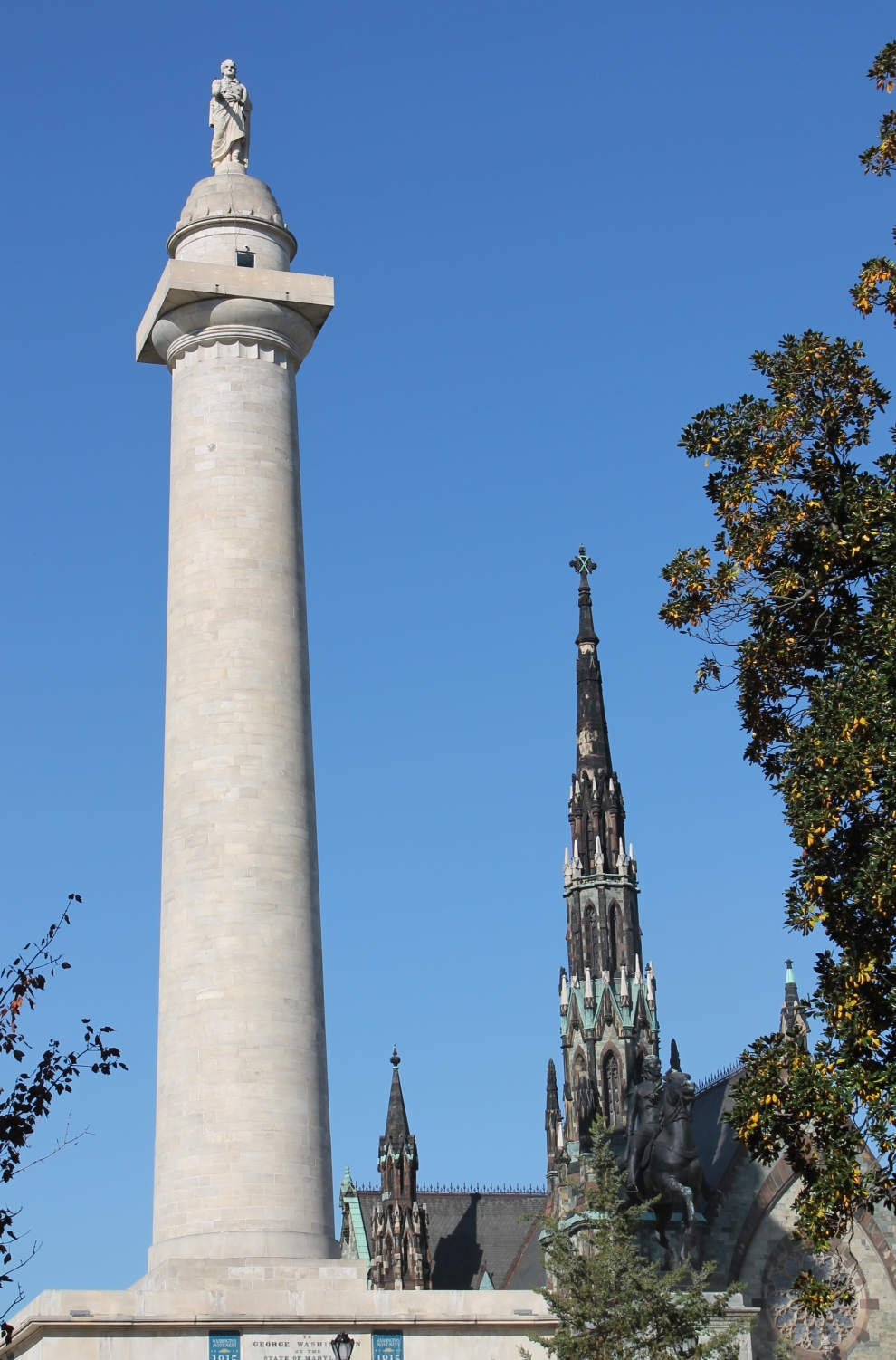
I’m home from my travels. I had a few good days with my brother and sister-in-law. I went on to Baltimore and the Maryland Center for History and Culture to do research on an ancestor who remains elusive. I also looked over the MCHC museum exhibits. I had time to see the Inner Harbor at sunset and walk around Baltimore’s Washington Monument at Mt. Vernon Place. Yeah, that’s George at the top of the column.
My drive from Baltimore to Bethesda was, alas, during rush hour, and was slow. Over the next two days I left my car at the hotel in Bethesda and took the Metro into Washington to see a couple museums. The first museum was the National Portrait Gallery and Smithsonian American Art Museum. Both are in the same building that says it is the third-oldest federal building in the capital. I concentrated on the portraits. The most famous portraits are, of course, the presidents. I didn’t get into that gallery. I did see the rooms of important Americans who lived 1600-1900 and were not presidents. This included politicians, explorers (Daniel Boone, William Clark (of Lewis and ... ) ), well known rich dudes, socialites, theater people, and prominent natives. I saw a few more rooms that showed famous people from the 20th century and a balcony gallery showed 20th century people in theater, movies, and music. That evening I went to a concert of a local bell ensemble that performed one of my pieces. This was the reason for the trip. They gave a competent performance. The ensemble had asked for submissions of music not yet published, something every composer has. I sent three pieces and pleased they chose one of mine from the sixty submitted. Several of the musicians said it was the most fun to play. Alas, getting to the concert was slowed by rush hour traffic (though it was a Saturday!) and confusing signs about which were toll roads, which were not, and how one was supposed to pay. So my supper was fast food. A musician suggested an alternate route back to my hotel to avoid the tolls – and that road had lots of construction work. At one point I took a wrong turn and I didn’t know how to get to my hotel from there. Then I remembered my new car has a map app! As soon as I could I turned off the commanding voice giving directions. Also in Washington I visited the African American Museum – the full name is the National Museum of African American History and Culture. I did not see the history galleries on the lower levels because the line to get in was 35-45 minutes. However, the community and culture exhibits on the 3rd and 4th floors were plenty to see in one day. These floors had exhibits on African Americans in the military, in sports, in visual arts, on stage and screen, and in music. The last was a large display. There was also a gallery of black people making a place for themselves such as a hat maker who served both black and white customers. There was also a display of the Chicago Defender, a black owned newspaper with a circulation of a half million. Train porters snuck copies into the South where it helped fuel and guide the Great Migration. This poem is part of the exhibit of black people in the military. It is by Langston Hughes from “Beaumont to Detroit: 1943” You tell me hitler Is a mighty bad man. I guess he took lessons from the ku klux klan ... Cause everything that hitler And mussolini do, Negroes get the same Treatment from you ... I ask you this question Cause I want to know How long I got to fight BOTH HITLER–and JIM CROW. I had earlier learned that the Nazis devised many of their policies through studying Jim Crow laws. I also learned the original Jim Crow was a minstrel character of that name. He was a happy-go-lucky plantation slave reinforcing the racial stereotypes. The character was developed by white performer Thomas D. “Daddy” Rice. I do have a minor complaint of this fine African American Museum – there is very little about those who were both black and LGBTQ. Those I knew to be gay, such as James Baldwin, were not identified as gay. The little bit of LGBTQ content I saw was a poster for the 1989 documentary Tongues Untied, directed by Marlon Riggs. That made me realize I hadn’t seen any other LGBTQ exhibits. Here’s a nice photo of the Lincoln Memorial from the 2nd floor windows of the museum.
The weather was good for the trip, though a couple evenings were cold. Most trees were in full color, making for a beautiful drive. The whole trip was about 1160 miles. Michigan’s COVID data, updated Tuesday, shows the last several weekly peaks of new cases per day at 2015, 1990, 1876, 1576, and 1577. Cases are heading in the right direction, but the disease is still not gone. Deaths per day are in the same low range they’ve been at since May. I did not collect browser tabs while traveling, mostly because my travel computer is so cranky and slow I read only a few news articles on any day I had time to read. So what I share today (and likely the rest of the week) is from the last couple days. Mark Sumner of Daily Kos wrote about the ongoing protests in Iran. Tuesday marked the 40th day since the death of Mahsa Amini which sparked these protests. In Iran 40 days marks the end of a mourning period. To commemorate it (tens of?) thousands of protesters walked to her grave in the town of Saqez. When security blocked roads they walked through fields. Security at Sharif University tried to keep the male and female students separate. Students fought back and took control of the campus. In solidarity a woman removed her hijab after wearing it for 80 years. Protesters in the town of Amol knelt before riot police to show they’re not afraid. It seems protesters are working to make sure they have a voice when the regime falls. They want to avoid the power vacuum that was exploited last time. In a Ukraine update on Tuesday Sumner reported Russia has lost its leverage over Europe. Putin had been saying if Europe didn’t meet his demands then he would cut off gas and oil and Europe would freeze in the dark. But now gas storage facilities in Germany are 97% full and they have so much of a buffer that gas prices have fallen. Europe is also turning to renewable energy as fast as it can. So Putin’s threats aren’t so threatening anymore. It is good to hear Democrats talking like this. Republicans have been claiming that Biden caused inflation (nope, it’s a corporate greed and worldwide problem) and they will be the fiscally responsible ones. Joan McCarter of Kos reported that on Monday Biden said:
Hear this closely: The Republicans have made it clear that if they win control of the Congress, they will shut down the government, refuse to pay our bills, and it’ll be the first time in our history America will default—unless I yield and cut Social Security and Medicare. There’s nothing, nothing, that will create more chaos, more inflation, and more damage to the American economy than this. ... We, the Democrats, are the ones that are fiscally responsible. Let’s get that straight now, okay? We’re investing in all of America, reducing everyday costs while also lowering the deficit at the same time. Republicans are fiscally reckless, pushing tax cuts for the very wealthy that aren’t paid for, and exploiting the deficit that is making inflation worse.
Gabe Ortiz of Kos reported Charlie Crist, in a debate against Florida Gov. Ron DeathSantis, got off a few pointed comments. Crist accused his opponent of not being in search of solutions, but rather a “wedge issue.” Yeah, there are challenges at the southern border, but that stunt of luring immigrants with lies and flying them to Martha’s Vineyard, while using taxpayer money is just inhumane and not the way to change policy. Crist also asked DeSantis whether, if elected, he’ll serve the full four year term. Since DeSantis acts like he intends to run for president in 2024 he couldn’t give Crist or viewers an answer. Here are some cartoons describing what Republicans are doing: Jan Sorensen of Kos shows a couple discussing a voter guide. There are Democrats facing a guy wanting to get rid of Social Security, a woman who admires Hitler, and a guy who wants to smite the Bidens. So vote – if you can get past the vigilantes “watching” the ballot box. Pedro Molina has a cartoon of an elephant telling a driver he should be outraged by gas prices, but the car is up on blocks because tires labeled “democracy” and “rights” are being carried away. Btowncubsfan tweeted a photo of the Capitol attack with the caption, “Why would I worry about who’s crossing the border when these assholes are already here?” Dave Whamond has a cartoon with an elephant carrying a sign that says. “Ban books, Critical Race Theory, Unisex Bathrooms, Trans kids,” and a few more. A woman says, “Let me guess ... There’s no room for ‘guns’ on that list.” The elephant replies, “What? Are you Crazy?” Phil Hands has a cartoon showing an elephant with a sign that says, “Defund schools, child care, Social Security, Medicare, Medicaid, Health care, Mental Health, Democracy, etc.” A donkey has a sign that says “Defund Police.” The elephant says, “You’re too Radical!” Walter Einenkel of Kos reported Twitter had a few things to say about a campaign stunt by Republican Sen. Todd Young of Indiana. Young is shown at a gas pump with the sign for a price of $3.99 a gallon above his head with a caption blaming Biden for high gas prices. Twitter quickly noticed Young is not standing beside a car. Also, gas prices are down from their peak. Indiana Progressives tweeted, “If you think things are expensive now just imagine what it will be like after the Republicans take away your Social Security, Medicare, Medicaid, unemployment benefits and affordable health care.”

Wednesday, August 10, 2022

Transitions of the Heart

In my two previous posts about my handbell vacation I forgot to mention a nice story. I was reminded of it when I went through my notes today. One feature of these international handbell gatherings is that individual bell choirs, small ensembles, and soloists can play a piece or two for the assembled crowd. We were able to hear the Icelandic college students and the wonderful team from Hungary and many others. One of the American choirs that played, this one from New York, were at a table just behind me. They all wore something with the colors of the transgender flag – white, pink, and pastel blue. The men wore bowties and the women wore scarves. With those colors I knew something was up. The announcer said they were playing a piece titled “Transitions of the Heart” by Matthew Compton, one of the young composers of the handbell world. It was commissioned by two members of the group who each have a transgender child. The music depicted some of the joy and anguish of being transgender. Well done! I finally copied photos of the trip from my camera. Here are a couple of them. First is of part of the massed ringing floor – most of the center section and a bit of the right section. There wasn’t a place to stand to include the left section because the podium was taller than the bleachers. Those gigantic bells are for the bottom octave. They’re made of aluminum because bronze bells for those pitches are too heavy. The aluminum bells are lighter and much bigger. The things that look like downspouts are chimes and the tall ones in racks sound that same bottom octave (for a lot less money and space). There are chimes that match the pitches of the bells over the entire range. They provide a lovely contrast in sound and a lot of composers in the program wrote for both bells and chimes.
The other photo is of downtown Nashville taken from the pedestrian bridge over the river. This is where I went when I got tired of the music at the Wild Horse Saloon.
The last time I downloaded Michigan’s COVID data was three weeks ago. After a low point in June the number of new cases per day has been slowly rising, much more slowly than the delta variant rise a year ago. Since the beginning of July the weekly peaks have been 2423, 2413, 2508, 2598, and 2762. The data for this week doesn’t appear to be in yet. The number of deaths per day has remained below 20 with occasional days above that. That low level has been consistent for about 4½ months – since mid March. Walter Einenkel of Daily Kos wrote about the FBI searching the nasty guy’s Mar-a-Lago estate. They had a search warrant, which means they were able to show a judge that they expected to see evidence of a crime. While there was speculation about which crime they expected to see evidence of (that alone is quite telling for this guy) it seems they were looking for documents, some perhaps top secret, that should have been turned over to the National Archives on leaving office. Einenkel linked to more thorough posts and focused on the Fox News response (they’re freaking out) and some of the memes that have appeared. A tweet by Elad Nehori sums up the Republican and far right response:
The “they cry out in pain when they strike you” is a popular line among white nationalists and antisemitic groups. The origin is a Polish proverb: “The Jew cries out in pain as he strikes you.” It has been popular meme in TheDonald for quite some time.
Strange that the nasty guy’s ranting response to the raid seems to have been written before the raid happened. Brandi Buchman of Kos is one of those who provided more detail with context and history. Hunter of Kos discussed some of the Republican and conservative outrage over the search. Many of the suggestions are quite violent. The FBI isn’t commenting on the search and ongoing criminal investigation as is appropriate – if they did Republicans would rant about how it is improper to announce an investigation. Never mind the FBI did announce an investigation once, having to do with Hillary Clinton’s emails with the announcement coming just before the 2016 election. As part of their caterwauling Republicans demand to know the contents of the search order. Of course, the FBI shouldn’t and won’t say. However, there is one guy who could reveal the contents of the search order, including the laws suspected to have been broken – the nasty guy. So far he hasn’t. No surprise. David Neiwert of Kos reported that social media has lit up with discussions that this political persecution against their Dear Leader is bad enough the response should be the start of a civil war. In other news, Buchman reported the US Court of Appeals ruled 3-0 that the nasty guy must turn over all of his tax returns since 2015 to the House Ways and Means Committee. The ruling says the Committee has a valid reason for requesting them. Buchman wrote:
In 1974, when it become public knowledge that Nixon was not properly audited by the IRS, the Presidential Audit Program went into effect, mandating that every president has his returns scrutinized by the tax agency. That law hasn’t changed to date. Because Trump was a “unique taxpayer” with returns that were “inordinately large and complex,” the committee was rightfully concerned that the audit program might not account for all of Trump’s vast business interests and activities, Tuesday’s ruling notes.
Therefore Congress, as part of appropriately designing laws, does have a valid interest in the nasty guy’s tax returns. No surprise if the nasty guy stalls and appeals. Yesterday I wrote about a CBS story that made arms not getting to the Ukraine front sound like a scandal. Charles Jay of the Kos community reported that CBS has deleted the tweet promoting the faulty documentary and removed the doc from their website. They have also tweeted they now know it is faulty and will re-edit it to remove the misinformation. Jay said the source of much of the info in the documentary is from Jonas Ohman. Head of Blue/Yellow, a pro-Ukraine non profit. Ohman’s quote in the doc is from late April and things have changed a lot since then. Also, Ohman’s organization deals with non-lethal military aid (helmets and such) and he had no knowledge of how weapons are distributed. Which means CBS should have recognized Ohman wasn’t an appropriate source. Alas, Reps. Lauren Boebert and Marjorie Taylor Greene – and Russian propaganda outlets – have already jumped on the original CBS doc as representing a scam.

Tuesday, August 9, 2022

In position to spring a trap

In my travelogue, posted yesterday, I missed a piece of the story. Through the whole trip when out in public and not eating I wore a mask. It wasn’t a top rated mask, though one I could wear for long periods. About Tuesday evening during my week at the handbell events (with hundreds of people around) I had a mild sore throat. That disappeared quickly, though my nose was soon dripping. And, yeah, I had a pretty good idea what this was, having had similar symptoms in January. On Wednesday I put on an N95 mask. I tolerated it for about a half day. It hurt the bridge of my nose. It’s straps insisted on primary positions around my ears so my glasses didn’t seat well and fell off when I bent over. Thursday evening the entire Symposium went to Nashville’s Wild Horse Saloon for supper and a party. The band was loud, so little talking. The staff gave line dancing lessons and the dance floor was full, so I didn’t join in. At least the food was good. While there I had to lower my mask to wipe my nose. After a couple hours (and a friend was surprised I lasted that long) I left the party to walk around a bit of downtown Nashville, then headed to the bus to go back to the resort. Once back I immediately went to bed. When I was awake during Wednesday night I had arguments with myself. A runny nose in the time of COVID should mean I get tested. If positive I should go home. Doing otherwise is irresponsible. But I really want to stay for the big final concert! When awake Thursday night I came around to the right thing. I could still change my reservation at the hotel in Cincinnati, pulling it ahead a couple days and avoiding 10 hours of driving in one day. In the morning I should call them, then go to the massed ringing floor and gather up my stuff and say quick goodbyes. My nose stopped dripping when I went to bed Thursday night. It sometimes does that when I sleep. But Friday morning it didn’t resume. So I stayed. And continued to keep my mask on as much as possible. When I got home yesterday there was an email from a friend with whom I had spent a lot of time. She had tested positive and suggested I get tested. She didn’t say anything about strong or mild symptoms. Though I kept my mask on whenever possible I don’t think I ever saw her wearing one. From what little news I read during the trip I emailed eight links to myself. I also accumulated another six from today’s reading. So some of these might get only a quick mention. And I won’t get to all of them tonight. I’ll start with a couple Ukraine updates: On August 5 Kos of Daily Kos noted that Ukraine has announced very little about their progress in Donbas, yet everyone from Zelenskyy on down has been talking about an imminent counteroffensive against Kherson. Why warn Russia well ahead of what they intend to do? It looks like all that talk of Kherson is to draw Russia into reinforce their position there – drawing soldiers and equipment from other fronts. That part looks to be working. Once in the Kherson area it looks like Ukraine will be in position to spring a trap, where Russia can’t supply their troops and they must surrender. At the same time Ukraine has a clearer path towards its real target – to take out key supply line depots, shutting down Russia’s ways to keep its army going (not that it is all that good at it now). On August 7 Hunter of Kos wrote about a couple of news reports that criticize Ukraine. They’re really Russian propaganda. The first, by CBS, complains that only 30% of all the military equipment sent by NATO to Ukraine has actually reached the front lines. The way this report is written makes it sound like a scandal. Hunter replied: First that the 30% number was plucked out of thin air. Second, even if it is accurate that’s a good thing. Hunter explains why an army doesn’t want all of its military resources on the front line at any one time. One does not want all available rockets sitting beside the launchers. What is a front line now hopefully won’t be a front line next week. Some weapons need to be held back to be able to respond when the enemy attacks at a new location. And not all military aid promised by NATO is intended for the front lines – some of it is for training well back from the front. The other report is from Amnesty International and it complains that Ukraine, because it is fighting in urban areas, is endangering civilians. Hunter, and everyone else paying attention, replied that Ukraine is fighting in urban areas because Russia is attacking in urban areas. And Russia is conducting a war of conquest and genocide. This sort of statement allows Russia to avoid responsibility of bombing Ukrainian residential buildings. Even Zelenskyy issued a condemnation. It looks like the head of Amnesty Ukraine tried to prevent the article from being published, and when that failed, resigned. Eventually Amnesty issued a non-apology. A lot of watchers have said Amnesty International has lost all trust in its main humanitarian campaign. Hunter reported that all Senate Democrats – including Manchin and Sinema and with VP Harris breaking the tie – passed a bill with critical climate protection, inflation, and healthcare components. It’s a lite (very lite) version of Biden’s campaign promise Build Back Better plan. It even includes a minimum corporate tax! The bill went through as reconciliation, meaning Republicans couldn’t filibuster it. The Senate parliamentarian said a provision to cap insulin prices did not meet reconciliation rules, so needed 60 votes. It got 57. Joan McCarter of Kos reported on some of the details of this bill. A big chunk of money for clean energy and electric vehicles. It allows Medicare to negotiate drug prices. It makes health care coverage more affordable. It funds the IRS so it can go after corporate tax cheats. McCarter also reported on what it took to get Manchin’s vote. And it’s a dirty deal. There is a Mountain Valley Pipeline going through Virginia and West Virginia that isn’t finished because residents oppose it. So permits have been held up. The White House promised to approve the permits and Manchin got a promise of a vote on separate legislation to stop further legal challenges to the permits. Even with that dirty deal, there is still lots for Democrats to celebrate. Greg Dworkin, in a pundit roundup for Kos, had a few interesting quotes. Adrianna McIntyre tweeted:
If you want a preview of midterm ads this fall, look at the latest tweets using the word “insulin”
Republicans know voting against an insulin price cap would be a big opening for Democrats. They did it anyway. Dworkin quoted a tweet from Amanda Carpenter that quoted a New York Times article saying Rep. Liz Cheney has a red line on which Republicans she would support for president in 2024. Does the candidate state clearly that the nasty guy lost a legitimate election in 2020? So far supporting Gov. Ron DeSantis of Florida would be very difficult for her. Dworkin quoted Rex Huppke of USA Today, known for his snark.
You may have noticed high gas prices have swiftly and rudely become less high, a trend that, if it continues, threatens to rob Republicans of a glorious midterm election cudgel. Democrats are undoubtedly to blame, but lowering gas prices isn’t the only way they’re sticking it to well-meaning Republicans. They’re also trying to help veterans and passing legislation aimed at lowering inflation. All this governing is an outrage and a clear political shot at the long-standing Republican philosophy that says the government shall help only rich people.

Monday, August 8, 2022

Bells from around the world

I’m home. It was an enjoyable two weeks. I’m glad I went. I’m also glad to be home. I left home two weeks ago Monday. From then to the following Saturday afternoon I visited Niece’s family. Brother was also there as was his second daughter. Niece has four children, three boys 8½, 6, and 1, and a girl 4½. We had an outing most days and one evening friends with children of similar ages came over to see the Miyazaki movie Whispers of the Heart. I enjoyed that one. I left Saturday afternoon and drove on to Nashville. The national handbell event began late Sunday morning. It was held at the Gaylord Opryland Resort. This is a huge place. It’s the largest non-casino hotel with over 2,800 rooms and enough convention hall space for 4-5 simultaneous conventions – there were three during my time, the Knights of Columbus, a Stream Revitalization group, and us. And there were convention halls not in use. The space includes three grand atriums with lush plants, fountains, and waterfalls. I didn’t stay there. Rooms were over $200 a night. That might have been tolerable for one night, but not for eight. I found a hotel nearby with a rate of $130 a night. It was only a mile away. Even so I drove my car from one to the other. And that first day I found the resort charges non-guests $33 a day for parking. I had lots of thoughts of greedy corporate types making a buck anyway they could. So I drove back to my hotel and walked. At event registration I learned one could drive to the mall just beyond the resort and park just outside resort property and do it for free. Even so it took 10 minutes to walk from the car to the event convention area (rather than 30 minutes to walk from my hotel to the convention area). The national event ended and the International Handbell Symposium started Monday evening. That program included the parade of flags and an international handbell choir of college students (plus a few adults) who had been rehearsing since Saturday. They did a difficult program wonderfully well. Much of the international event was taken up by all of us forming a mass handbell choir. I heard the number of ringers was about 330. That’s small for this event that has been happening alternate years for almost four decades and has prompted much of my international travel. Usually there are 500-800 ringers and one event (about a decade ago) getting up to 1200. The international event is organized by handbell guilds in the US, Canada, Britain, Japan, Korea, Australia-New Zealand, Hong Kong, and Singapore. This year the normally large numbers of ringers from Japan and Korea didn’t come. We did get a college age choir from Iceland, a five member team from Hungary, a choir from Puerto Rico, and a single ringer from Brazil. In addition to all the rehearsals the schedule included some classes. I attended one about Iceland and one about saying a few words in Cantonese. I also took part in a session on what we want to see in future International Symposiums. The attendees of that session said clearly the big draw for the Symposium is getting to know people from other countries. So make sure there is time to do that, such as during meals and other events. Draw people together. And in our tiny way promote peace. The final concert, featuring directors from each organizing country and music from most (the Korean’s chose an American hymn arrangement), went very well. The concert was livestreamed, though from one stationary camera showing about a third of the ringers (the video guy was stuck at the Denver airport because of weather). Alas, that means the video doesn’t show the extra percussion, the flutist, the speaker to introduce each piece and conductor, and many times not even the conductor. The music sounds pretty good. The images are not so great. I just watched it online. I did it partly to hear some of the music that happens while I’m playing my few particular bells. In the pop tune from Singapore I heard the melody while playing, but didn’t notice the many other things going on in the music. I also watched because I was told the video will be up only through today. After hearing the pieces again I’m going to have them as earworms again. The massed ringing concerts for 2016 and 2018 (the 2020 event was canceled) are still on YouTube (search for International Handbell Symposium) and if this one stays it will be there too. I started home on Sunday. I drove through a long and strong rainstorm between Louisville and Cincinnati. I got into Cinci in time to spend a couple hours at the Underground Railroad Museum. I then walked along the Riverfront for a bit. Then I drove up to the Eden Park Overlook. After that I had dinner, then found my motel. I had considered going to the Cinci Zoo this morning (and had chosen a motel near it). But the weather forecast said sunny and would feel like 90F by 11:00. So I skipped it and came home. I had chosen the zoo only because the many interesting museums in town are closed Mondays. A few days before the trip I took my car in to repair the air conditioner. The coolness had been lasting only a half hour and I was planning 5-6 hours of driving a day. I was told it was low on coolant, so paid to have it topped up. Yesterday I noticed the AC wasn’t always blowing cool air. Today it stopped. The trip home got quite warm. Whoever checked the coolant didn’t check why it was low. They probably thought with a car this old (16 years and 200K miles) the coolant was low just because of age. I’ll have to give them a call soon. I did read some of the news while sitting in hotel rooms in the evening. I saved a few links to share – some other day.

Thursday, August 31, 2017

Home again

I'm home again, arriving at 6:30 this evening. A big stack of mail and a few phone messages awaited.

Yesterday, my brother, sister-in-law and I visited the Bayernhof Museum near Pittsburgh. Sister-in-law's sister had suggested it. We had to call ahead to reserve a spot for the 2:00 tour -- and the three of us and the guide were it!

Charlie Brown was a small-scale manufacturer in Pittsburgh and through that became wealthy. He was also eccentric. When, in his 30s, he finally moved out of his mother's house, he built this mansion with the idea that it would someday be a museum. He decorated it in a Bavarian style to remember an ancestor who came from there. He wanted to bring Bavaria to Pittsburgh.


However, he knew Bavarian things would not be enough to entice the public, so he also bought mechanical musical instruments -- player pianos, mechanical dance bands, carousel organs, and the like -- even though he didn't particularly like them.


Charlie drew up rough plans for the house, though didn't hire an architect to create full blueprints. He hired Johnny, then 17 years old and about to go to college as an engineering student, as his general contractor. What a hands-on project for a student! Johnny, with the help of a master carpenter and assistants, constructed the house over several years. Johnny never built another house, though is still working as an engineer and willing to consult on the house -- answering questions such as what does this switch do and what is behind this wall?

So we toured the house, including the secret passages, the cave, the observatory that Johnny installed for himself, and the pool. We heard many of the mechanical instruments. And we heard stories -- lots of great stories -- about Charlie and his eccentricities. It was a fun afternoon.

Of course, we had to find a German restaurant for supper.

Tuesday, August 29, 2017

Miles and miles

Since I last posted...

On Sunday I spent the afternoon with my aunt. After sitting for a while I suggested we walk. We went out the end of her hall and around the back of the building. I suggested we walk around the next hall. She said she couldn't, too far ... and then did. We rested a bit on the far side of the building then went back to her room. Once settled in her chair she fell asleep for perhaps 10 minutes.

That evening I played some family card games with my cousin and his kids until the kids went to bed.

On Monday I was up early enough to see my cousin and the kids off to work and school. I then got myself ready and packed. My day was a drive from Charlotte to Pittsburgh to visit my brother and his wife. Google maps suggested 7 hours. It was more like 8. A few stops and the total time was well over 9 hours. One of those stops was at the overlook on the New River Gorge Bridge (I was there for only 20 minutes, honest!).

Today included a walk in a park and general lounging around.

Saturday, August 26, 2017

A modest little shack

I haven't been getting an early start in the morning -- this is vacation -- so I left Cherokee at about 10:00 on Thursday. The Blue Ridge Parkway begins in Cherokee, just outside the Great Smoky Park. I took it. The signs say the speed limit is 45 mph, but with the hills and curves I rarely got that fast. The drive is lovely and most of the frequent overlooks provide fine views of the Blue Ridge Mountains (and allow faster traffic to pass). But after an hour I decided I didn't want to spend another two to get to Asheville. So I took the exit and was soon on I-40.

Back in the 1800s Cornelius Vanderbilt made piles of money on railroads. In the late 1880s his grandson George bought 8000 acres near Asheville and built his house, Biltmore Estate. It was completed in 1895. It is the largest single-family residence in America at over 177,000 square feet, more than 140 times the size of my modest house. In addition, he hired Frederick Law Olmsted to landscape the grounds (most of which was reverted from farmland to forest).


I took the audio tour -- I was given a device and at each of the 39 sites I tapped in the number and put it to my ear. They suggested the tour might take 2 hours. I took nearly 3.


The second room to view is the formal dining room. We're told it measures 40 feet by 70 feet, or 2800 square feet, more than twice the size of my house. Some have remarked the room doesn't look big, but the whole house is on such a large scale. This dining room includes a pipe organ, which automatically plays about every half hour (an organist is hired for special occasions).


After touring a few of the bedrooms (I think there are 32 in the house) and the servant areas (and hearing about the daily duties) I realized this isn't just a home, it is also a resort for the well connected. Guests would come for perhaps weeks at a time to be entertained by the Vanderbilts and their staff.

When hearing about how the super-rich treat their servants I look for whether the servants are exploited. It appears in this case the Vanderbilts rewarded their servants well. The rooms in the servant quarters are nicer than in most mansions and Edith Vanderbilt honored servants at holidays, birthdays, and such. Some families served the Vanderbilts for 2 or 3 generations. Even so, the chief cook did not have a bedroom like George Vanderbilt's.

My pricey entry ticket included access to the winery and village (whether I wanted to visit or not) and the exit road out of the estate made sure I passed all these areas (it took 20 minutes from the time I got to my car until I got to the outside world).

From the estate gate to my cousin's house near Charlotte took two hours.

On Friday I spent time with my aunt, Dad's sister. She is in an assisted living home and doing pretty well for 87. I told her about my trip so far and about family news.

Today most of my cousin's family is lounging about, when not freaking out about school starting on Monday. Both of his kids are in middle school. My cousin, his son, and I took bicycles into a Charlotte park for about a 45 minute ride. If I was on my own bike we could have gone farther, but his daughter's bike was a bit small for me and I couldn't get the power for hills.