Many pundits have said that with such high unfavorable ratings of both major candidates this is a good year for the alternatives, such as the Libertarian and Green party candidates. I'm pleased that Gary Johnson of the Libertarian Party seems stuck at under 9%, though it would be good if he pulled a few more votes from Trump.
The editors of Shareblue take a look at four parts of the Libertarian platform, though it can be summed up rather easily: I've got mine. Too bad you don't have yours.
Taxes: Johnson is saying we should eliminate all income, property, and business taxes and fund the government with a consumption (sales) tax. But the consumption tax is the most regressive tax – the poor have to spend (and be taxed) on a much higher percent of their income than the rich for daily living. For a poor person, about 100% of their income would be taxed. For a rich person that might be 1% of their income.
Minimum wage: Johnson doesn't support it. Want more money? Switch jobs or become an entrepreneur! But some people don't have the education to switch jobs (see below) and there aren't enough higher paying jobs for everyone who wants one. As for being your own boss, because of racism and classism many people can't get a business loan.
Education: Johnson says college should not be free (something Sanders pushed, and Clinton has taken up). As for public schools, Johnson wants to abolish the federal Dept. of Education. Too bad if you're in a state that routinely underfunds its schools and refuses to teach sound science (such as evolution) or demands teaching abstinence-only sex ed.
Healthcare: Johnson has said there is no way a government can have a system that manages health care. He must not have tangled with an insurance company denying coverage. Johnson insists a, "market-based approach should be the foundation of any solution." But it is easy to show that proper health care is incompatible with the profit motive. (Several other things incompatible with the profit motive are here).
The Libertarian Party platform doesn't work for marginalized people – and not even for the young of the well-to-do who are just starting out on their own.
The Libertarians say they are fiscally conservative and socially liberal. I'm sure they mean they approve (or at least don't disapprove) of same-sex marriage. But socially liberal means more than that. Just one example: it means everyone gets a good K-12 education and doesn't have huge college debts weighing them down. So fiscally conservative and socially liberal can't mix.
Showing posts with label Fiscal Conservatism. Show all posts
Showing posts with label Fiscal Conservatism. Show all posts
Tuesday, September 20, 2016

Saturday, January 23, 2016
Drip, drip, drip...
The contaminated water in Flint, Michigan is now making national news. There are lots of news sources to fill in the details of that nightmare and lots of opinion about how it wouldn't have happened in a rich white city.
Though as for that last bit...
Oliver Milman, writing for The Guardian, reports:
Is my water also contaminated?
My water has always been a bit off. It can turn the bowl of a toilet orange (not too bad when I had a yellow toilet) and has a slightly musty taste. About 20 years ago the city partnered with a company to test the water of individual homes. I put out a sample of water to be tested, then found out they wouldn't give me the results unless they could also give me a sales pitch for their filtering products. I decided their results must be unreliable and said no.
Perhaps 3 years ago I had enough of the musty taste and bought a pitcher with a water filter. I still get water straight from the tap when I brush teeth (the pitcher is in the kitchen), though it looks like that needs to change. But does the filter trap lead or enough other harmful stuff? My nutritionist sells a super-duper model (with matching price) but it is big and I don't have space in my kitchen. She has also suggested I buy a filter for the shower. It might be time to do that.
The Guardian saw data gathered by Dr. Yanna Lambrinidou of Virginia Tech. The article also included this:
Though as for that last bit...
Oliver Milman, writing for The Guardian, reports:
Water authorities across the US are systematically distorting water tests to downplay the amount of lead in samples, risking a dangerous spread of the toxic water crisis that has gripped Flint, documents seen by the Guardian show.That bit about Detroit definitely caught my attention. The Detroit water system, now the Great Lakes Water Authority supplies water to all of the Detroit Metro Area – and now including Flint again. Does that bit about Detroit mean the city, or the entire Detroit area water system?
…
Documents seen by the Guardian show that water boards in cities including Detroit and Philadelphia, as well as the state of Rhode Island, have distorted tests by using methods deemed misleading by the Environment Protection Agency.
Is my water also contaminated?
My water has always been a bit off. It can turn the bowl of a toilet orange (not too bad when I had a yellow toilet) and has a slightly musty taste. About 20 years ago the city partnered with a company to test the water of individual homes. I put out a sample of water to be tested, then found out they wouldn't give me the results unless they could also give me a sales pitch for their filtering products. I decided their results must be unreliable and said no.
Perhaps 3 years ago I had enough of the musty taste and bought a pitcher with a water filter. I still get water straight from the tap when I brush teeth (the pitcher is in the kitchen), though it looks like that needs to change. But does the filter trap lead or enough other harmful stuff? My nutritionist sells a super-duper model (with matching price) but it is big and I don't have space in my kitchen. She has also suggested I buy a filter for the shower. It might be time to do that.
The Guardian saw data gathered by Dr. Yanna Lambrinidou of Virginia Tech. The article also included this:
Lambrinidou warned that the issue of misleading test results was widespread. “There is no way that Flint is a one-off,” she said.“There are many ways to game the system. In Flint, they went to test neighbourhoods where they knew didn’t have a problem. You can also flush the water to get rid of the lead. If you flush it before sampling, the problem will go away.Do we thank years of the GOP trying to squeeze the gov't by not budgeting enough money? Is the EPA scared because of GOP rants on excessive regulations and has long been targeting the agency? Is this what Libertarians mean when they promote small gov't so it doesn't intrude on our freedom? Are we all supposed to have our own water purification system, responsible for the safety of our own water?
“The EPA has completely turned its gaze away from this. There is no robust oversight here, the only oversight is from the people getting hurt. Families who get hurt, such as in Flint, are the overseers. It’s an horrendous situation. The system is absolutely failing.”
Sunday, December 27, 2015
Actually snake oil
Lynn Parramore, writing for Huffington Post Politics, interviewed Orsola Costantini, Senior Economist at the Institute for New Economic Thinking, about the Cyclically Adjusted Budget used by many governments around the world. It is an imprecise statistical estimate that guides government officials when they decide what to spend money on and how much money to collect in taxes.
In the 1940s the CAB was a great thing. It helped convince business owners that policies to put Americans to work after the war were good for business. It allowed the economic experts and the budget wonks, not just politicians, to give blessings to these policies.
But because it is imprecise the CAB is easily manipulated. In these times of income inequality and power held by the 1% we know who is doing the manipulating and in whose favor. The use of the CAB allows politicians and businessmen to...
* Use language that is technical and obscure, giving a veneer of objectivity that is indisputable.
* Avoid taking responsibility of their decisions. The CAB and budget wonks made me do it.
* Make drastic cuts in social spending as well as personal pay and benefits in the name of economic science, the smooth running of capitalism, or to keep inflation low.
* Limit choices available to fix a budgetary situation. We can't raise taxes! We'll face economic doom!
Through the CAB governments are able suck money from the poor to give to the rich.
Costantini said:
Bill Moyers, also writing for Huffington Post Politics, takes a look at the budget bill recently passed by Congress and quickly signed by Obama. He lists many of the goodies for the 1% tucked in its 2000 pages. Did we expect anything else? The official spin, which news anchors uncritically amplified, was that it was a bipartisan bill that proved Washington can work. It isn't a perfect bill, but does a lot of good things.
Moyers asks the important questions: Washington works for whom? It does a lot of good things for whom? At what price?
Moyers wrote:
In the 1940s the CAB was a great thing. It helped convince business owners that policies to put Americans to work after the war were good for business. It allowed the economic experts and the budget wonks, not just politicians, to give blessings to these policies.
But because it is imprecise the CAB is easily manipulated. In these times of income inequality and power held by the 1% we know who is doing the manipulating and in whose favor. The use of the CAB allows politicians and businessmen to...
* Use language that is technical and obscure, giving a veneer of objectivity that is indisputable.
* Avoid taking responsibility of their decisions. The CAB and budget wonks made me do it.
* Make drastic cuts in social spending as well as personal pay and benefits in the name of economic science, the smooth running of capitalism, or to keep inflation low.
* Limit choices available to fix a budgetary situation. We can't raise taxes! We'll face economic doom!
Through the CAB governments are able suck money from the poor to give to the rich.
Costantini said:
I suppose this shows the limits of democracy when information, knowledge, and ultimately power are unequally distributed.And...
Even the name of this tool, the “cyclically adjusted budget,” carries an aura of respect. It diverts our attention. We don’t question it. It creates a barrier between the individual and the political realm: it undermines democratic participation itself. This obscure theory validates, with its authority, a big economic mistake that sounds like common sense but is actually snake oil — the notion that the federal government budget is like a household budget. Actually, it isn’t. Your household doesn’t collect taxes. It doesn’t print money. It works very differently, yet the nonsense that it should behave exactly like a household budget gets repeated by politicians and policymakers who really just want to squeeze ordinary people.
Bill Moyers, also writing for Huffington Post Politics, takes a look at the budget bill recently passed by Congress and quickly signed by Obama. He lists many of the goodies for the 1% tucked in its 2000 pages. Did we expect anything else? The official spin, which news anchors uncritically amplified, was that it was a bipartisan bill that proved Washington can work. It isn't a perfect bill, but does a lot of good things.
Moyers asks the important questions: Washington works for whom? It does a lot of good things for whom? At what price?
Moyers wrote:
Can we at least face the truth? The plutocrats and oligarchs are winning. The vast inequality they are creating is a death sentence for government by consent of the people at large. Did any voter in any district or state in the last Congressional election vote to give that billion dollar loophole to a handful of billionaires? To allow corporations to hide their political contributions? To add $1.4 trillion to the national debt? Of course not. It is now the game: Candidates ask citizens for their votes, then go to Washington to do the bidding of their donors. And since one expectation is that they will cut the taxes of those donors, we now have a permanent class that is afforded representation without taxation.
Thursday, July 24, 2014
Cut taxes for economic growth
The NPR program Morning Edition took a look at the race for governor in Kansas. There an interesting thing has happened. One hundred current and former moderate GOP state legislators endorsed – the Democratic candidate. Sam Brownback, the current GOP governor, did exactly what he campaigned on – cut taxes. He said it would boost growth and create jobs. He eventually wants to eliminate the income tax.
What it did was create a huge budget deficit and the state's economic growth is now slower than the national rate. Brownback says give the cuts time to do their work. He tells the story of meeting a small business owner who will use the tax savings to grow his business.
What is happening in Kansas demonstrates the fallacy of the GOP claims about tax cuts. They say lower tax cuts attract businesses to the state. But others (such as those 100 GOP lawmakers) are finding out what attracts business investment is a diverse and educated workforce and sound infrastructure. And massive tax cuts puts both in jeopardy.
What it did was create a huge budget deficit and the state's economic growth is now slower than the national rate. Brownback says give the cuts time to do their work. He tells the story of meeting a small business owner who will use the tax savings to grow his business.
What is happening in Kansas demonstrates the fallacy of the GOP claims about tax cuts. They say lower tax cuts attract businesses to the state. But others (such as those 100 GOP lawmakers) are finding out what attracts business investment is a diverse and educated workforce and sound infrastructure. And massive tax cuts puts both in jeopardy.
Thursday, January 10, 2013
Advantage lost
Essayist Terrence Heath was not at all pleased with the recent Fiscal Bluff deal. Yeah, Obama got at least some in the GOP to vote for higher taxes. But…
The middle class and poor got a tax raise too with a bump in the payroll tax (which pays for Social Security). That averages out to about $83 a month for some people who can't afford it.
The deal affects only the tax side of the equation. The spending side was postponed until March. In the process, Obama lost his bargaining advantage. If the GOP stalled on raising taxes, they would raise anyway, which is what Obama wanted. But now if nothing happens the spending cuts will occur anyway, which is what the GOP wants. The GOP is able to hold the economy hostage again (and again, with the debt ceiling coming due).
African-Americans, Asians, and Latinos now play a significant role in the national votes of several states. They see the positive role of gov't and don't want social programs cut. If Democrats vote for cutting important programs (all because the GOP has them over a barrel) the Dems would alienate all these non-white voters. Even so, I doubt they would vote for the GOP, though it is possible the GOP would be happy if all these non-white voters didn't vote.
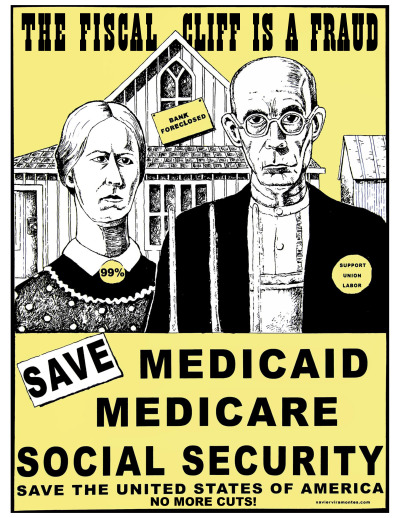
Rebuild the Dream held an Artstrike, asking people to create posters that capture the idea that the fiscal bluff is a fraud, created so the rich can extort more money from the poor. Here is my favorite.

And I'll close with a summary I used just a few days ago:
The middle class and poor got a tax raise too with a bump in the payroll tax (which pays for Social Security). That averages out to about $83 a month for some people who can't afford it.
The deal affects only the tax side of the equation. The spending side was postponed until March. In the process, Obama lost his bargaining advantage. If the GOP stalled on raising taxes, they would raise anyway, which is what Obama wanted. But now if nothing happens the spending cuts will occur anyway, which is what the GOP wants. The GOP is able to hold the economy hostage again (and again, with the debt ceiling coming due).
African-Americans, Asians, and Latinos now play a significant role in the national votes of several states. They see the positive role of gov't and don't want social programs cut. If Democrats vote for cutting important programs (all because the GOP has them over a barrel) the Dems would alienate all these non-white voters. Even so, I doubt they would vote for the GOP, though it is possible the GOP would be happy if all these non-white voters didn't vote.
Rebuild the Dream held an Artstrike, asking people to create posters that capture the idea that the fiscal bluff is a fraud, created so the rich can extort more money from the poor. Here is my favorite.
And I'll close with a summary I used just a few days ago:
The only entitlement that needs reforming is the inbred belief of the 0.1% that they are entitled to 99.9% of the wealth and 100% of the power.
Sunday, December 2, 2012
Delicate Position
NPR's Weekend Edition this morning had a report on one aspect of why the fiscal bluff might be hard to resolve. David Welna says the House GOP created three rules that will get in the way.
* The Majority of the Majority. No bill will come up for a vote in the House unless a majority of GOP members are in favor of it. This prevents passage of any bill in which Dems might peel off 40 of the over 200 GOP House members.
* Any increase in the Debt Ceiling (which will be hit a couple months after this fiscal bluff mess is sorted out) must be matched by an equal cut in spending.
* The No New Taxes pledge.
That leaves Boehner in a delicate position. He may not be able to cut a deal with Obama without breaking at least one rule. If he breaks a rule his position as Speaker may be in jeopardy.
* The Majority of the Majority. No bill will come up for a vote in the House unless a majority of GOP members are in favor of it. This prevents passage of any bill in which Dems might peel off 40 of the over 200 GOP House members.
* Any increase in the Debt Ceiling (which will be hit a couple months after this fiscal bluff mess is sorted out) must be matched by an equal cut in spending.
* The No New Taxes pledge.
That leaves Boehner in a delicate position. He may not be able to cut a deal with Obama without breaking at least one rule. If he breaks a rule his position as Speaker may be in jeopardy.
Thursday, November 29, 2012
A crack in the tax pledge
Essayist Terrence Heath notes a few GOP senators and reps are allowing that some revenue enhancements might be tolerated. With that some Dems are crowing that Grover Norquist and his no new taxes pledge are on the way out. But Norquiest himself appears quite unconcerned with all the commotion. Why?
It's all a bargaining ruse. With all that talk (and the GOP isn't offering much) they can portray themselves as conciliatory, ready to do some serious horse-trading. That way when they ask for huge cuts on Medicare and Medicaid it will be the Dems who look obstructionist. The GOP is betting the Dems blink first. Once they take a whack out of those two programs the money will never be restored.
Do Medicare and Medicaid need to be reformed? Word I've heard is yes -- they should be shifted from a fee-for-service model (which promotes excess tests and treatment) to one that rewards wellness. But it seems the GOP wants cuts, not changes in the funding model (which benefits their backers).
An example of the GOP tactic appeared tonight on NPR's All Things Considered. Host Robert Siegal talked to Dave Camp, the GOP chairman of the House Ways and Means committee (the one that makes sure all the relevant programs actually get funded). True to the script Heath outlined, Camp trumpeted the willingness to be flexible on revenue while demanding to see what programs the Dems were willing to cut. All the while he did an amazing dodge-and-weave of not answering Siegal's actual questions.
Jim Greer, former chairman of the Republican Party in Florida, has come right out and said it. All that stuff about laws to prevent voter fraud? A ruse. The real reason for it is voter suppression. Which has at least one commenter wondering where is the prosecution for treason?
It's all a bargaining ruse. With all that talk (and the GOP isn't offering much) they can portray themselves as conciliatory, ready to do some serious horse-trading. That way when they ask for huge cuts on Medicare and Medicaid it will be the Dems who look obstructionist. The GOP is betting the Dems blink first. Once they take a whack out of those two programs the money will never be restored.
Do Medicare and Medicaid need to be reformed? Word I've heard is yes -- they should be shifted from a fee-for-service model (which promotes excess tests and treatment) to one that rewards wellness. But it seems the GOP wants cuts, not changes in the funding model (which benefits their backers).
An example of the GOP tactic appeared tonight on NPR's All Things Considered. Host Robert Siegal talked to Dave Camp, the GOP chairman of the House Ways and Means committee (the one that makes sure all the relevant programs actually get funded). True to the script Heath outlined, Camp trumpeted the willingness to be flexible on revenue while demanding to see what programs the Dems were willing to cut. All the while he did an amazing dodge-and-weave of not answering Siegal's actual questions.
Jim Greer, former chairman of the Republican Party in Florida, has come right out and said it. All that stuff about laws to prevent voter fraud? A ruse. The real reason for it is voter suppression. Which has at least one commenter wondering where is the prosecution for treason?
Sunday, March 14, 2010
Racist, yeah. Homophobic? Well…
I -- and lots of other people -- have commented on the low-info and racist nature of the Tea Party movement. These are people focused on fiscal responsibility, though they didn't seem to mind how quickly the government spent money when a white guy was prez. There are now several commentators (including from the Christian Science Monitor and New York Times) noting the Tea Party people want nothing to do with the social conservatives who want to ban abortion and gay marriage. Too much of a distraction to the real issue at hand. That leads to the question, will the Tea Party people be good or bad for gays? Hard to tell when a movement defines itself by what it is against. We may have to wait until they endorse candidates.
Yes, indeedie, this question touched off a heated debate. How much of a distinction is there between Tea Party supporters and the Fundies who are happy to associate with them if it would get Obama and Dems out of power?
Yes, indeedie, this question touched off a heated debate. How much of a distinction is there between Tea Party supporters and the Fundies who are happy to associate with them if it would get Obama and Dems out of power?
Tuesday, February 9, 2010
Taxes are too high!
Michigan has been knocked back on its kiester due to the shrinking of the auto industry. The state budget is a mess with cuts to everything. The Detroit Free Press has reported in the past that the state tax system is structured around a robust auto industry and it will never contribute the taxes it has in the past. It's time to restructure the tax system to get revenues from the 21st century economy based on services. Naturally, the GOP controlled state senate is sticking to its no new taxes pledge, easily making the Dem governor dance to their tune. School systems and state universities faced cuts this year and are crying for help.
That leaves me wondering just exactly does the GOP consider to be essential government services. The answer appears to be: None. Their goal seems to be no government at all.
Focus on the Family, the Fundie organization that has long said nasty things about gays, has its headquarters in Colorado Springs. Several other Fundie and conservative groups have made their home in the city and now control its politics. The city has rejected tax increases and the city treasury will soon be empty. Already a third of the street lights are out; parks, pools, and museums are about to close; there aren't enough firefighters or cops; no busses on weekends; no more street paving. The newly homeless residents no longer have social services and are setting up tent ghettos. Taxes still too high?
I've wondered if the Michigan governor would ever consider sitting down with the majority leader of the senate and go over every item in the budget, saying, "Do you believe the government should pay for… -- yes or no." Then go on to how much, then on to how to pay for them. She could then go to the public and say, "This is what the GOP thinks are the only things government should pay for. Do you agree?" Alas, she's too much of a wimp and the GOP are too evasive to be pinned down that clearly.
That leaves me wondering just exactly does the GOP consider to be essential government services. The answer appears to be: None. Their goal seems to be no government at all.
Focus on the Family, the Fundie organization that has long said nasty things about gays, has its headquarters in Colorado Springs. Several other Fundie and conservative groups have made their home in the city and now control its politics. The city has rejected tax increases and the city treasury will soon be empty. Already a third of the street lights are out; parks, pools, and museums are about to close; there aren't enough firefighters or cops; no busses on weekends; no more street paving. The newly homeless residents no longer have social services and are setting up tent ghettos. Taxes still too high?
I've wondered if the Michigan governor would ever consider sitting down with the majority leader of the senate and go over every item in the budget, saying, "Do you believe the government should pay for… -- yes or no." Then go on to how much, then on to how to pay for them. She could then go to the public and say, "This is what the GOP thinks are the only things government should pay for. Do you agree?" Alas, she's too much of a wimp and the GOP are too evasive to be pinned down that clearly.
Wednesday, October 15, 2008
Getting in the way of a good scapegoat
So what just happened with the world-wide financial system? According to blogger Alex Blaze (whose credentials are unknown), perhaps it was because:
The Community Reinvestment Act was designed to end "red-lining," where banks discriminated because of where the borrower lived. It requires banks to give money to low-income borrowers. And, of course, "low-income" borrowers are really people who are so messed up they can't hold a job and can't afford a house and are certainly incapable of repaying a mortgage. Which means the mess was caused by Democrats and affirmative action for mortgages. But don't let the facts get in the way of a good scapegoat.
And those facts?
Only a quarter of the faulty subprime mortgages came from institutions subject to the CRA. And those that were under the law made fewer dangerous loans.
Fannie and Freddie weren't allowed to take part in subprime mortgages. They can only work with loans with down payments and documented income.
If a bank makes a loan to a borrower they know cannot repay the loan, why does the borrower get the blame and not the bank? Doesn't that prove the bank's incompetence? For the record, the bank makes the loan because they get a fee for creating the loan. The loan is sold to someone else so the bank doesn't care whether the loan is repaid or not because they already have their fee.
While bad loans are at the heart of the problem there were other things that magnified it: deregulation and credit default swaps that hid the value of loans.
So why is that other story being pushed? The pushers can claim (other than "It's the Democrat's fault") such things as the problem isn't deregulation, but over-regulation, or the problem is dangerous minorities.
That last bit resonates when we might be electing our first black president while Palin stokes the fires of racism. Those pushing this particular story can claim the country will be screwed if Obama is elected (meaning we're not now?).
Stir that brew and add a bit more seasoning: McCain, the war hero, is being humiliated -- by black man -- and some people are taking that humiliation personally. As Obama pulls us out of Iraq (and a conservative goal of using Iraq as an American base to subdue the rest of the region is discarded) there will be calls that America was stabbed in the back by liberals (a claim that was made in Germany at the end of WWI and set the groundwork for WWII). The coming recession will be long and hard. All that means the racial hatred will bubble for most of the first term of an Obama presidency.
America used to be above such things. But the temptation to abuse racism to advance politics may be too strong to resist. In the second debate McCain hit most of the counternarrative points mentioned above. Will he do it in the third? (I'm not going to watch and will only hear about it in tomorrow's news).
Massive deregulation caused an explosion in the buying and selling of arcane and opaque securities, creating a huge bubble (bigger than all the money in the whole world put together!) that burst as real wages dropped, bad loans stopped being paid, and investors started to ask for real money on their investments.
But that explanation is woefully inadequate to a certain segment of Americans for several reasons:
1. It finds fault with free market fundamentalism, the foundation of conservatism
2. It places the blame on Republicans and a smaller group of "fiscally conservative" Democrats
3. It might usher in an era of increased regulation and raise class consciousness to where Americans are less willing to accept income inequality
So conservatives have started a counternarrative, blaming the current housing crisis on any of a number of factors, such as Fannie Mae, Freddie Mac, the Community Reinvestment Act, and poor people who couldn't repay their loans. By extension, the assault is on Democrats, social justice, and racial minorities.
The Community Reinvestment Act was designed to end "red-lining," where banks discriminated because of where the borrower lived. It requires banks to give money to low-income borrowers. And, of course, "low-income" borrowers are really people who are so messed up they can't hold a job and can't afford a house and are certainly incapable of repaying a mortgage. Which means the mess was caused by Democrats and affirmative action for mortgages. But don't let the facts get in the way of a good scapegoat.
And those facts?
Only a quarter of the faulty subprime mortgages came from institutions subject to the CRA. And those that were under the law made fewer dangerous loans.
Fannie and Freddie weren't allowed to take part in subprime mortgages. They can only work with loans with down payments and documented income.
If a bank makes a loan to a borrower they know cannot repay the loan, why does the borrower get the blame and not the bank? Doesn't that prove the bank's incompetence? For the record, the bank makes the loan because they get a fee for creating the loan. The loan is sold to someone else so the bank doesn't care whether the loan is repaid or not because they already have their fee.
While bad loans are at the heart of the problem there were other things that magnified it: deregulation and credit default swaps that hid the value of loans.
So why is that other story being pushed? The pushers can claim (other than "It's the Democrat's fault") such things as the problem isn't deregulation, but over-regulation, or the problem is dangerous minorities.
That last bit resonates when we might be electing our first black president while Palin stokes the fires of racism. Those pushing this particular story can claim the country will be screwed if Obama is elected (meaning we're not now?).
Stir that brew and add a bit more seasoning: McCain, the war hero, is being humiliated -- by black man -- and some people are taking that humiliation personally. As Obama pulls us out of Iraq (and a conservative goal of using Iraq as an American base to subdue the rest of the region is discarded) there will be calls that America was stabbed in the back by liberals (a claim that was made in Germany at the end of WWI and set the groundwork for WWII). The coming recession will be long and hard. All that means the racial hatred will bubble for most of the first term of an Obama presidency.
America used to be above such things. But the temptation to abuse racism to advance politics may be too strong to resist. In the second debate McCain hit most of the counternarrative points mentioned above. Will he do it in the third? (I'm not going to watch and will only hear about it in tomorrow's news).
Thursday, February 21, 2008
End of Conservatism?
Rush Limbaugh hates John McCain. Limbaugh hates how the old guard GOP is now lining up behind McCain. Lawrence Eagleburger, one of the old guard, says "Who elected Rush as the head of this conservative movement?" Limbaugh responds, "We're trying to avoid a landslide!" I assume he means a landslide that would bury the GOP.
I don't listen to Limbaugh (can't afford to waste the brain cells) and thus don't really know if he is a social conservative (like Dobson) or some other flavor of GOP. I really don't care and for me it is beside the point anyway. However, I'll use this opportunity to highlight a Newsweek article declaring the death of Conservatism, and by this columnist Fareed Zakaria means a fiscal conservative in the mold of Reagan. The complaint by many is that Bush hasn't been a fiscal conservative and McCain isn't one either. The GOP would be so much better if the party would return to its fiscal roots. Recent research shows that such a return would make the GOP less appealing, not more. The public really does like the new Medicare Drug Program and are willing to forego tax cuts to get it. Reagan's tax cuts served a real purpose at the time (top rate was 70%). But running on Reagan's policies today makes the GOP seem so … 70's.
Subscribe to:
Posts (Atom)